
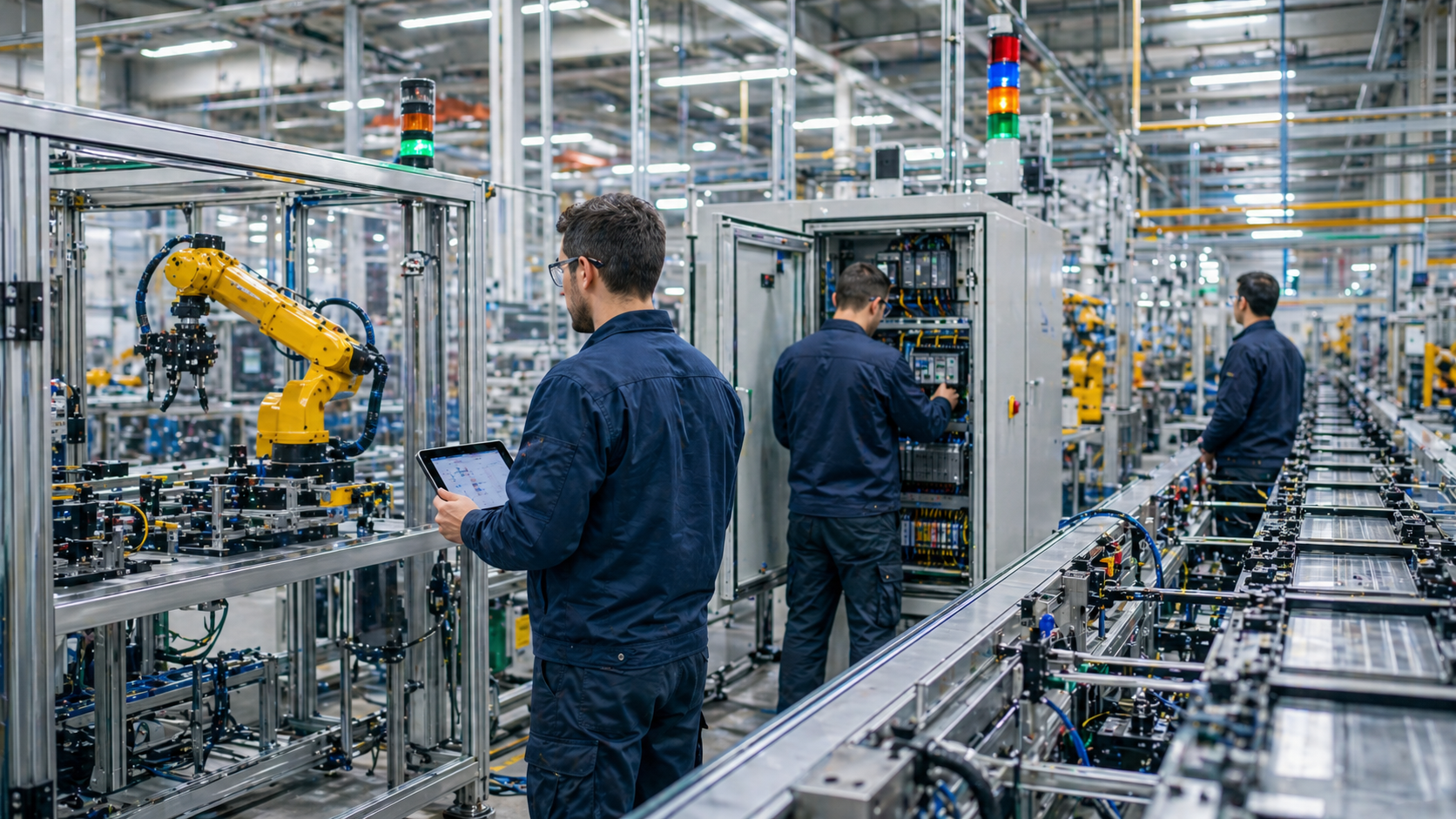
Walk into a modern factory today and you’ll see something very different from what most people imagine.
It’s not rows of workers doing repetitive tasks.
It’s robots. Conveyor systems. Vision cameras. Automated lines moving at high speed.
And behind all of it?
A small group of highly skilled people keeping everything running.
Right now, there’s a massive opportunity hiding in plain sight:
Industrial automation is becoming the new blue-collar gold rush.
The Shift Nobody Is Talking About
For decades, manufacturing jobs followed a familiar pattern:
- Show up
- Do repetitive work
- Get paid hourly
That world is disappearing.
In its place, factories are becoming highly automated systems that depend on a different kind of worker:
- People who can troubleshoot machines
- People who understand electrical systems
- People who can read PLC logic
- People who can program robots
- People who can fix problems fast
This is not traditional “labour.”
This is technical blue-collar work.
And demand is exploding.
Why This Is a Gold Rush
A gold rush happens when three things line up:
- High demand
- Low supply
- Clear value creation
Automation checks all three.
Factories across Canada and the U.S. are investing heavily in robotics, automation, and smart manufacturing to stay competitive.
Companies like Tesla, Toyota Motor Manufacturing Canada, and Amazon are building and upgrading highly automated facilities.
But here’s the problem:
- The equipment is advanced
- The systems are complex
- And there are not enough people who know how to run them
That gap is where the opportunity lives.
The Jobs That Are Printing Money
Inside automated factories, a handful of roles carry outsized value.
PLC Programmers
They control the logic of machines.
If something breaks, they fix it.
If something needs to be improved, they change the code.
No PLC = no production.
Controls Technicians
These are the troubleshooters.
They diagnose faults, trace signals, fix issues, and keep systems alive.
They are often the difference between:
- A line being down for 10 minutes
- Or down for 10 hours
Robot Programmers
Robots don’t run themselves.
People are needed to:
- Teach positions
- Debug faults
- Optimize cycles
- Integrate new tooling
Factories are adding more robots every year.
That means more demand for people who understand them.
Industrial Electricians (Who Can Do More)
The old version:
- Wiring
- Conduit
- Panels
The new version:
- Electrical + automation
- Power + logic
- Hardware + troubleshooting
This hybrid skillset is one of the most valuable in the entire plant.
Automation Technicians
These are the all-around problem solvers.
They touch everything:
- PLCs
- Sensors
- HMIs
- Drives
- Pneumatics
- Conveyors
They are not stuck in one lane.
And that makes them extremely valuable.
Why Almost Nobody Is Positioned for This
Here’s the strange part:
Even though the opportunity is massive, most people are not moving toward it.
Why?
Because the path is not clearly explained.
- Electricians stay electricians
- Millwrights stay millwrights
- Engineers stay behind desks
But the real value is in the overlap.
The people making the most money are often:
- Electricians who learned PLCs
- Techs who learned robotics
- Engineers who actually understand the plant floor
They become the bridge.
And bridges get paid.
The Barrier to Entry Is Lower Than You Think
This is not a “go back to school for 4 years” situation.
Most people break into automation by:
- Learning ladder logic
- Getting exposure at work
- Helping with troubleshooting
- Volunteering for automation projects
- Moving into maintenance or controls roles
If you’re already in the trades or manufacturing:
You are closer than you think.
The Real Advantage: You Can’t Outsource This
One of the biggest advantages of automation work:
It has to be done on-site.
You can’t outsource:
- Fixing a production line
- Commissioning a robot cell
- Troubleshooting a PLC fault in real time
Factories need people physically there.
That gives these roles:
- Job security
- Leverage
- Consistent demand
Where This Is Happening Right Now
This “gold rush” is strongest in:
- Automotive manufacturing
- Food and beverage plants
- Warehousing and logistics
- Packaging facilities
- Battery and EV plants
- Plastics and materials processing
Regions like:
- Ontario (Windsor, GTA, Kitchener-Waterloo)
- Michigan (Detroit area)
- Ohio
- Texas
- Tennessee
- The Carolinas
are full of facilities investing heavily in automation.
Employers Are Quietly Competing for Talent
If you’re on the hiring side, you already see it.
Posting for:
- PLC techs
- Controls engineers
- Robot programmers
And getting:
- Low-quality applicants
- Not enough experience
- Or no applicants at all
The best people are already working.
And they are being pulled in multiple directions.
That is what a labour shortage actually looks like.
This Is the Career Move That Changes Everything
If you are:
- An electrician
- A maintenance tech
- A millwright
- A mechanically inclined person
- Someone interested in how machines work
This is one of the highest-leverage moves you can make:
Learn automation.
Because instead of competing with everyone…
You move into a smaller pool where:
- Demand is higher
- Pay is higher
- Work is more interesting
- Opportunities are everywhere
The Bottom Line
There is a blue-collar gold rush happening.
But it’s not in oil fields or construction booms.
It’s inside automated factories.
The people who understand machines, logic, and systems are becoming some of the most valuable workers in the entire economy.
And right now:
There are not enough of them.
Want In?
If you want to break into this space — or level up inside it — start by looking at real roles:
- PLC Programmer
- Controls Technician
- Robot Programmer
- Automation Technician
- Industrial Electrician
These are the jobs shaping the future of manufacturing.
And they’re all in one place:
Ready to see what’s out there? Find PLC, controls, robotics, and automation jobs at FactoryAutomationJobs.com.
FAQ
Why are automated factories creating blue-collar opportunities?
Automated factories need skilled people who can troubleshoot machines, read PLC logic, work with electrical systems, program robots, and keep production running.
What jobs are part of the automation gold rush?
Key roles include PLC programmers, controls technicians, robot programmers, industrial electricians with automation skills, and automation technicians.
How can someone start moving into industrial automation?
Start by learning ladder logic, getting exposure to automation equipment at work, helping with troubleshooting, volunteering for automation projects, and moving toward maintenance or controls roles.
Use this guide
Turn this into a live factory automation job search
Compare current openings near Toronto, then save an alert so new reviewed PLC, controls, robotics, industrial electrical, commissioning, and field service roles come to you.