
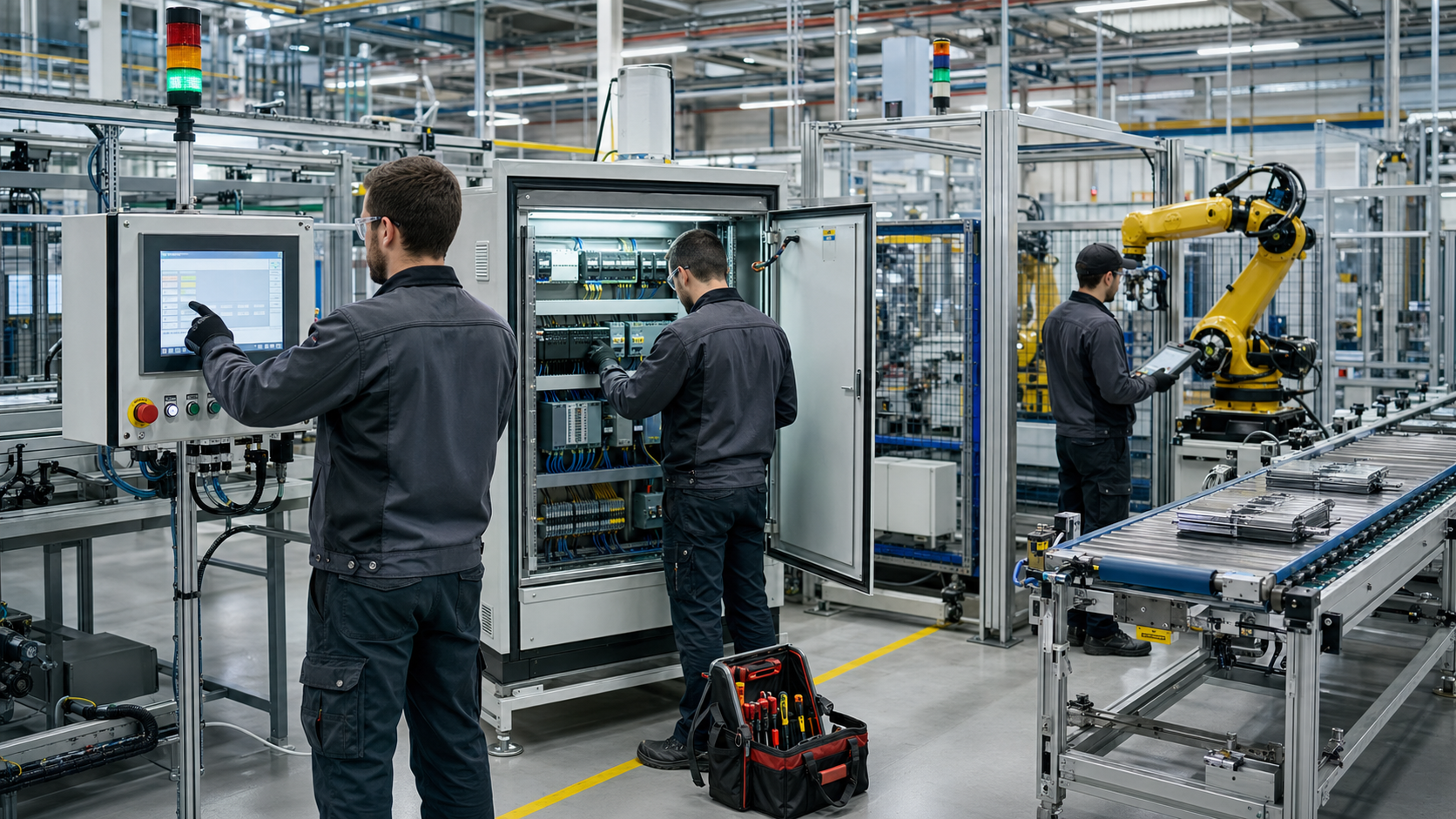
Factories do not just need “workers” anymore.
They need people who can keep automated equipment alive.
That means:
- PLC technicians
- Robot programmers
- Controls engineers
- Industrial maintenance electricians
- Automation technicians
- Field service controls techs
And right now, there are not enough of them.
That is the opportunity.
The Factory Job Market Has Changed
For years, people talked about automation like it would simply remove manufacturing jobs.
That is only half the story.
Yes, some repetitive production jobs are being replaced or reduced. But at the same time, factories are becoming more dependent on technical workers who can install, troubleshoot, program, and maintain automated systems.
Modern plants need people who understand:
- PLCs
- HMIs
- Servo drives
- Robots
- Vision systems
- Sensors
- Networks
- Safety circuits
- Automated conveyors
- Production data
The old factory needed hands.
The new factory needs hands and brains.
The Shortage Is Already Here
The U.S. manufacturing industry could need as many as 3.8 million new workers between 2024 and 2033, according to Deloitte and The Manufacturing Institute. Without major changes, about 1.9 million of those jobs could go unfilled.
Canada is dealing with the same kind of pressure. The federal government has pointed to skills shortages, supply chain disruption, rapid AI adoption, and emerging technologies as major labour-market challenges.
This is not just a “we need more people” problem.
It is a we need the right people problem.
Factories can usually find applicants.
What they cannot find easily are people who can walk up to a dead machine, open the electrical cabinet, connect to the PLC, understand the fault, and get production moving again.
That person is valuable.
The Jobs Nobody Is Training Enough People For
Here are the roles that matter most.
PLC Technicians
PLC techs troubleshoot automated equipment, read ladder logic, diagnose inputs and outputs, and help keep machines running.
They are often the bridge between electricians, maintenance teams, engineers, and production.
A good PLC tech does not just replace parts.
They understand the logic behind the machine.
Robot Programmers
Robot programmers are becoming more important as factories add robotic welding, material handling, palletizing, machine tending, and assembly systems.
These people work with brands like:
A robot can be expensive.
A robot that is down is even more expensive.
That is why companies need people who can program, touch up points, troubleshoot faults, and make robotic cells reliable.
Controls Engineers
Controls engineers design and improve the systems that run automated equipment.
They work with PLCs, HMIs, safety systems, motion control, electrical design, networks, and commissioning.
In a lot of plants, the controls engineer is the person everyone calls when nobody else can figure out what is wrong.
That is why this role has leverage.
Industrial Maintenance Electricians
The industrial electrician role is also changing.
It is not just conduit, motors, panels, and troubleshooting with a meter anymore.
The highest-value industrial electricians are becoming automation-capable electricians.
They can troubleshoot power and logic.
That combination is rare.
Automation Technicians
Automation technicians are the all-around technical problem solvers.
They may touch PLCs, robots, sensors, pneumatics, HMIs, conveyors, vision systems, and production equipment.
This is one of the best career paths for someone who likes solving real problems instead of sitting in meetings all day.
Why Almost Nobody Is Training for This
The problem is simple:
Most training systems are behind the factory floor.
A lot of schools still teach the basics.
A lot of companies are too busy trying to ship product to train properly.
A lot of tradespeople are never clearly shown the path from “electrician” or “maintenance tech” to “automation specialist.”
So people stay in their lane.
Electricians stay electricians.
Millwrights stay millwrights.
Engineers stay engineers.
But the best automation workers often come from the overlap.
They are the people who can understand the mechanical problem, the electrical problem, and the PLC logic problem at the same time.
That is where the money is.
Automation Is Not Killing the Best Jobs — It Is Changing Them
Automation is reducing demand for some traditional roles, but it is increasing demand for people who can work with advanced equipment. Manufacturing Dive reported that demand is growing for technicians who can work with robotics, maintain advanced equipment, and use data to keep production running smoothly.
That is the key point.
The safest position is not standing beside the machine doing repetitive work.
The safest position is being the person who understands the machine.
Employers Are Competing for the Same Small Talent Pool
If you are an employer, you already know the pain.
You post a job for a controls technician or PLC programmer.
You get applicants.
But many do not have the right mix of skills.
Maybe they know electrical, but not PLCs.
Maybe they know PLCs, but have never been on a real factory floor.
Maybe they have a degree, but cannot troubleshoot under pressure.
Maybe they are good technically, but cannot travel, work shifts, or handle commissioning.
That is why these roles are hard to fill.
The best people are already working.
And if they are good, someone else is probably trying to hire them.
This Is a Huge Opportunity for Workers
For job seekers, this shortage is not bad news.
It is a map.
If you want a stronger career in manufacturing, learn the skills that factories are desperate for.
Start with:
- Ladder logic
- PLC troubleshooting
- Industrial networking
- HMI basics
- Servo and VFD troubleshooting
- Robot programming basics
- Safety circuits
- Reading electrical drawings
- Understanding sensors and I/O
You do not need to know everything.
But every skill you add makes you harder to replace.
The Best Career Move: Become the Bridge
The most valuable people in automation are often “bridge” people.
They can talk to electricians.
They can talk to engineers.
They can talk to production.
They can talk to maintenance.
They understand what happens when a machine is down and everyone is staring at the same fault code.
That is why PLC techs, robot programmers, controls engineers, and automation technicians are so valuable.
They live where the real problems are.
Where the Demand Is Strongest
These roles are especially important in industries like:
- Automotive
- Food and beverage
- Packaging
- Warehousing and logistics
- Pharmaceuticals
- Plastics
- Metals
- Battery manufacturing
- Aerospace
- Consumer goods
Any plant with automated equipment needs people who can keep that equipment running.
And as more factories add robotics, vision systems, conveyors, and data collection, the need for skilled automation people only grows.
The Bottom Line
Factories are not just desperate for workers.
They are desperate for workers who understand automation.
That means the opportunity is sitting right in front of:
- Electricians who want to level up
- Maintenance techs who want better jobs
- Engineers who want practical factory-floor experience
- Robot techs who want to specialize
- PLC programmers who want more leverage
- Employers who need better ways to reach this talent
The future of factory work belongs to the people who can keep the machines running.
And right now, there are not enough of them.
Looking for Automation Jobs?
Factory Automation Jobs is built for the people who keep modern factories running.
Search roles like:
- PLC Technician
- Controls Technician
- Robot Programmer
- Controls Engineer
- Industrial Electrician
- Automation Technician
Ready to see where the demand is? Find automation jobs across Canada and the U.S. at FactoryAutomationJobs.com.
FAQ
What automation jobs are factories struggling to fill?
Factories are struggling to find PLC technicians, robot programmers, controls engineers, industrial maintenance electricians, automation technicians, and field service controls techs.
Why are automation workers in high demand?
Modern factories depend on PLCs, HMIs, robots, vision systems, sensors, networks, safety circuits, automated conveyors, and production data. They need workers who can install, troubleshoot, program, and maintain those systems.
What skills should someone learn to move into automation work?
Start with ladder logic, PLC troubleshooting, industrial networking, HMI basics, servo and VFD troubleshooting, robot programming basics, safety circuits, electrical drawings, sensors, and I/O.
Use this guide
Turn this into a live factory automation job search
Compare current openings near Ontario, then save an alert so new reviewed PLC, controls, robotics, industrial electrical, commissioning, and field service roles come to you.