
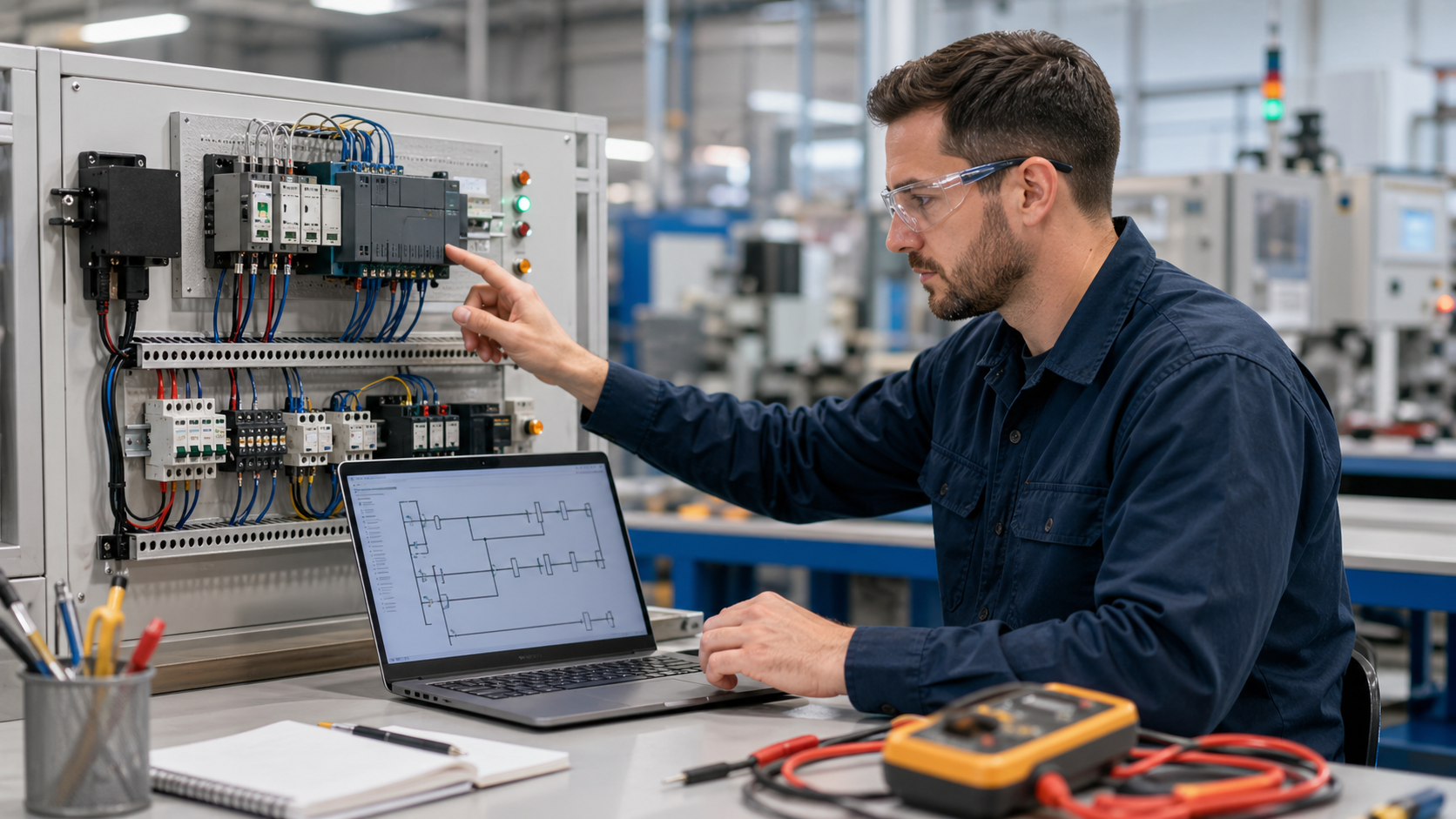
Training and Certification
If you are an industrial electrician and want to learn PLC programming, you are starting from a better position than you might think.
A lot of people try to learn PLCs from software first. They open a programming environment, look at ladder logic, and immediately feel like they are staring at a different language. Electricians have an advantage because they already understand the real-world side of the system: motors, sensors, contactors, drives, panels, safety circuits, wiring, and the strange things machines do when production is waiting.
That practical background matters. A PLC program is not just code. It is a control system connected to physical equipment. The more you understand the equipment, the easier it becomes to understand why the logic is written the way it is.
Start With What You Already Know
Most electricians already understand inputs and outputs, even if they do not use those words every day. A limit switch, photoeye, pressure switch, pushbutton, overload, or safety gate is an input. A motor starter, solenoid, pilot light, VFD enable, valve, or relay output is an output.
PLC programming starts to make more sense when you connect ladder logic back to that physical world. A rung is not abstract. It is often answering a simple machine question: is the sensor made, is the safety circuit healthy, is the motor allowed to run, has the timer finished, or should the next step in the sequence begin?
That is why industrial electricians can often become strong PLC programmers. They already know what the machine is supposed to do. The learning curve is mainly about reading and writing the logic that controls it.
Learn To Read Ladder Logic Before Writing It
The best first goal is not to build a huge program from scratch. It is to get comfortable reading ladder logic while thinking like a troubleshooter.
Start with basic instructions: normally open contacts, normally closed contacts, coils, timers, counters, latches, compare instructions, and simple move commands. Then connect each instruction to a real machine behavior. What has to be true before the output turns on? What condition stops it? What timer delays it? What fault bit prevents it from running?
This is where your electrical background helps. If you can follow a control circuit on a print, you can learn to follow ladder logic. The symbols look different, but the thinking is familiar.
Build A Small Practice Setup
You do not need a full production line to start learning. A small trainer can teach a lot if you use it properly. A basic PLC, a few switches, pilot lights, a small relay, and maybe a sensor or VFD can give you enough to practice real control problems.
Good starter exercises include:
- start-stop motor logic with seal-in behavior
- jog and run modes
- timer-based delays
- fault reset logic
- counter-based part counting
- simple sequence steps
- basic HMI pushbuttons and status indicators
The point is not to memorize instructions. The point is to build the habit of connecting field devices, PLC tags, logic, and outputs into one mental picture.
Learn Troubleshooting Before Fancy Programming
For many electricians, the fastest path into PLC work is troubleshooting. Plants often need people who can go online with a PLC, find out why a machine is stopped, and explain what condition is missing.
That means learning how to monitor logic safely, search for tags, read input and output status, trace permissives, understand fault bits, and compare what the PLC thinks is happening against what is physically happening on the machine.
This is also where the line between industrial electrician and automation technician starts to blur. If you can troubleshoot sensors, wiring, drives, safety devices, and PLC logic together, you become much more valuable than someone who only understands one piece.
Do Not Skip Safety And Process Knowledge
PLC programming is not only about making outputs turn on. In real plants, controls work touches safety, production quality, downtime, and equipment damage. Before changing logic, you need to understand what the machine does, what hazards exist, and what could happen if a sequence runs at the wrong time.
Electricians usually respect this quickly because they already know the consequences of bad assumptions in a live panel. Carry that same discipline into PLC work. Back up programs, document changes, understand the process, ask what the machine should do, and never treat a forced bit as a casual shortcut.
What To Learn After The Basics
Once ladder logic starts to feel readable, broaden into the areas that show up in real controls jobs.
- PLC hardware, I/O cards, addressing, and tag structure
- analog signals such as 4-20 mA and 0-10 V
- VFD control and drive fault handling
- HMI screens, alarms, recipes, and operator controls
- industrial networks such as Ethernet/IP or Profinet
- machine safety concepts and safe troubleshooting habits
- basic motion, servo, or robotics integration when your plant uses it
You do not have to master everything at once. The strongest learning path is usually tied to the equipment around you. If your plant uses conveyors, learn conveyor sequencing. If it uses VFDs, learn drive control. If it uses robot cells, learn how the PLC exchanges signals with the robot.
How To Move Toward PLC Programmer Roles
The jump from electrician to PLC programmer usually happens through proof. Employers want to see that you can troubleshoot real equipment, read existing programs, make controlled changes, and understand the process well enough to avoid creating new problems.
Look for chances to assist with controls projects, line upgrades, commissioning, downtime calls, and small improvements. Keep notes on what you learned and what you changed. Over time, those examples become stronger than saying you completed a course.
Courses and certificates can help, especially when they give you hands-on PLC time, but they work best when paired with real plant exposure. A hiring manager will usually care less about whether you watched a PLC video and more about whether you can explain how you found a missing permissive, fixed a sensor issue, adjusted a timer, or helped bring a machine back online.
The Bottom Line
Electricians do not need to become software developers to learn PLC programming. They need to learn how the logic connects to the equipment they already understand.
If you can read prints, troubleshoot controls, think safely, and stay curious about how machines sequence, you already have the foundation. Add PLC monitoring, ladder logic, tags, timers, counters, HMI basics, and networking step by step, and the path from industrial electrician to PLC programmer becomes much more realistic.
For electricians who want better long-term opportunities, learning PLCs is one of the most practical moves available. It can open the door to automation technician, controls specialist, robot programmer, and controls engineer career paths while keeping you close to the equipment that makes the work interesting.
Use this guide
Turn this into a live PLC programmer job search
Compare current openings near Ontario, then save an alert so new reviewed PLC, controls, robotics, industrial electrical, commissioning, and field service roles come to you.