
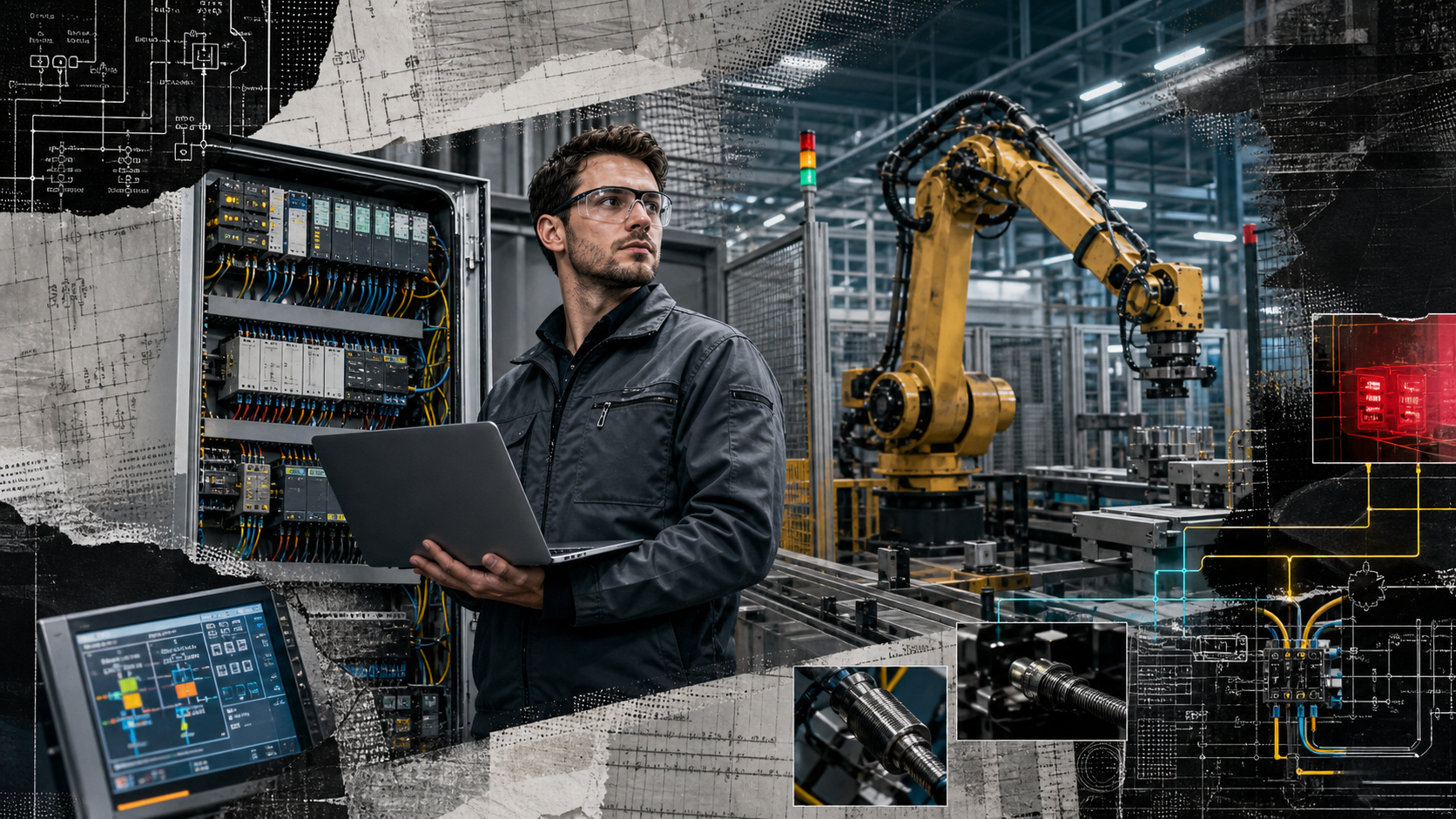
Everyone is trying to figure out what AI and robotics will do to the job market.
Will software jobs disappear? Will warehouses become fully automated? Will factories need fewer people? Will robots replace operators, material handlers, inspectors, packers, welders, drivers, and eventually half the office?
Maybe. Maybe not. The honest answer is that nobody really knows the exact timeline.
But there is one group of workers that looks increasingly important in almost every version of the future:
the people who can keep automated systems running.
PLC programmers. Controls technicians. Robot programmers. Industrial electricians. Automation techs. Maintenance people who understand sensors, drives, pneumatics, HMIs, networks, safety circuits, and production pressure.
If the world is going to automate more, someone still has to install, troubleshoot, maintain, modify, and improve all that automation.
That is why one of the smartest career moves right now is not to run away from automation.
It is to learn the machines that replace everyone else.
The future does not eliminate work. It changes where the valuable work is.
A lot of people talk about automation like it is magic.
A company buys a robot, installs it on the floor, presses a green button, and suddenly the line runs forever with no human involvement.
Anyone who has worked around real equipment knows how ridiculous that is.
Machines jam. Sensors get bumped. Cables fail. Operators find creative new ways to break things. Barcode readers stop reading. Vision systems hate dust, glare, oil, bad lighting, and real life. A cylinder that worked perfectly yesterday starts sticking today. A servo drive throws a fault at 2:13 a.m. and suddenly the entire plant is waiting on one person who knows where to look.
Automation reduces some kinds of labour, but it creates dependency on a different kind of labour.
The factory may need fewer people doing repetitive manual tasks, but it becomes more dependent on the people who understand the system.
That is the career opportunity.
The more automated the plant becomes, the more expensive downtime becomes. And the more expensive downtime becomes, the more valuable the good automation people become.
The safest worker in the plant might be the one who can make the robot move again
Imagine two workers in the same factory.
One person knows how to load parts into a fixture all day.
The other person knows how the fixture works. They know the PLC logic. They understand the light curtains, prox switches, cylinders, robot handshakes, fault messages, safety reset sequence, and why Station 40 keeps timing out after lunch.
Which one is safer long term?
That does not mean the first person is not hardworking or important. It means the second person is closer to the bottleneck.
And in manufacturing, bottlenecks matter.
When production stops, the plant does not care about job titles. It cares about who can get the line running.
That person might be a licensed electrician. It might be a controls engineer. It might be a maintenance tech who taught himself PLCs. It might be a robot programmer who knows just enough mechanical and electrical troubleshooting to be dangerous.
But the common trait is the same:
they understand the automated system well enough to diagnose reality.
That skill is hard to fake. It is hard to outsource. And it is hard to replace with a chatbot.
AI can help write code. It still cannot stand beside a machine at 3 a.m.
AI will absolutely change automation work.
It will help generate code. It will help write documentation. It will help search manuals faster. It may eventually help troubleshoot faults by looking at logs, screenshots, electrical drawings, and PLC code.
That is useful.
But troubleshooting automation is not just “knowing the answer.”
It is dealing with incomplete information in a physical environment.
The drawing says the sensor is wired one way. The panel says otherwise. The operator says it “just started happening,” but maintenance changed a cylinder yesterday. The robot fault says one thing, the PLC fault says another, and the actual problem is a half-broken M12 cable that only fails when the tooling is extended.
That is the part people outside the trade do not understand.
Factory automation is not clean software. It is software connected to metal, motion, air pressure, electricity, people, heat, vibration, bad installs, old drawings, and production managers asking how much longer it will be.
AI can become a powerful tool for automation workers.
But the worker who can combine AI with real machine knowledge becomes more valuable, not less.
The best automation people are not just “programmers”
There is a reason good controls people are hard to find.
The job sits at the intersection of multiple trades and disciplines.
You need enough electrical knowledge to understand I/O, circuits, panels, motors, VFDs, safety devices, and field wiring.
You need enough programming knowledge to understand logic, sequencing, data handling, alarms, interlocks, and machine states.
You need enough mechanical understanding to know when the code is fine and the real problem is a sticky cylinder, worn guide rail, loose coupling, bent bracket, or bad part presentation.
You need enough production sense to know what matters when the line is down.
And you need enough communication skill to explain the problem without making everyone in the room feel stupid.
That combination is rare.
A pure software person may not want to be on a factory floor.
A pure electrician may not want to dig into structured text, robot frames, or Ethernet/IP mapping.
A pure mechanical person may not want to troubleshoot safety circuits or PLC logic.
But the person who can cross those borders becomes extremely useful.
That is why the automation career path is so interesting. You do not need to be the smartest engineer in the room. You need to become the person who understands how the whole system actually works.
Automation creates fewer simple jobs and more technical jobs
This is the part people should take seriously.
Automation does not always mean fewer jobs overall, but it often means fewer easy-entry jobs on the production floor.
A manual process might need ten operators and one maintenance person.
An automated version might need two operators, one technician, one controls person, and a stronger maintenance team.
The total headcount might go down. But the technical value per person goes up.
That is uncomfortable, but it is also useful career information.
If you are already in manufacturing, the move is obvious: get closer to the equipment, the controls, the robots, and the troubleshooting.
If you are an operator, learn what happens after you press the button.
If you are an electrician, learn PLCs and industrial networks.
If you are a millwright, learn sensors, servo systems, and basic logic.
If you are a controls engineer, learn more about the physical machine instead of only living inside the laptop.
If you are a robot programmer, learn the PLC side and the process side.
The closer you are to the automated system, the better positioned you are.
The person who understands downtime has leverage
In manufacturing, downtime is brutally expensive.
A machine sitting idle is not just a machine sitting idle. It can mean missed shipments, overtime, scrap, angry customers, supervisors getting yelled at, and managers standing around a faulted cell pretending not to panic.
This is why good automation technicians have leverage.
Not because they have a fancy title.
Because they can turn a dead line back into a running line.
That is real value. It is measurable. Everyone can feel it.
When you solve the fault that has stopped production for three hours, nobody needs a presentation explaining why your job matters. The machine running again is the presentation.
That is also why automation skills travel well between industries.
Automotive, food and beverage, packaging, pharmaceuticals, warehousing, battery plants, metal forming, plastics, consumer goods, and general manufacturing all need people who can understand automated equipment.
The exact machines change. The core skill set carries over.
Inputs. Outputs. Faults. Sequences. Safety. Motion. Networks. Sensors. Drives. Troubleshooting.
That language shows up everywhere.
Robots do not remove the need for people. They raise the standard for people.
There is a lazy version of the automation story that says:
“Robots are coming, so humans are screwed.”
A more accurate version is:
“Robots are coming, so humans need to move up the skill chain.”
That does not mean everyone needs to become a PhD roboticist. It means more people need to understand the systems around them.
A factory full of advanced equipment still needs humans. It just needs humans with different skills.
Someone has to commission the line.
Someone has to recover it after a crash.
Someone has to adjust the vision inspection when the part colour changes.
Someone has to modify the program when the product changes.
Someone has to figure out why the robot keeps missing the pick position.
Someone has to explain why the machine is not actually the problem and the upstream process is feeding it garbage.
The more complex the automation, the more valuable that person becomes.
The best job security is becoming hard to replace
No job is perfectly safe.
Plants close. Companies restructure. Technology changes. Bad managers make bad decisions. Entire industries shift.
But you can still put the odds in your favour.
The weakest career position is being easy to replace and far away from the core value of the business.
The strongest career position is being hard to replace and close to expensive problems.
Automation workers can be very close to expensive problems.
When a plant depends on automated equipment, the people who understand that equipment are not optional. They are part of the production system.
That does not mean every automation job is amazing. Some are underpaid. Some plants run people into the ground. Some companies expect one controls person to cover an entire facility with no support and a laptop from 2014.
But as a skill set, automation is positioned incredibly well.
The world wants more productivity, more reshoring, more robotics, more data, more traceability, more quality control, and less dependence on repetitive manual labour.
All of that points toward more automation.
And more automation points toward more need for people who can make it work.
The career move is clear: become the person who understands the machine
If you are early in your career, do not just chase the cleanest job title. Chase exposure.
Work somewhere you will see real equipment. Integrators can be brutal, but they can also teach you five years of lessons in two years. Maintenance roles can be chaotic, but they teach you what failure actually looks like. Commissioning can be stressful, but it forces you to understand the difference between theory and production.
If you are already experienced, keep stacking skills.
Do not be “just” the PLC person. Learn robots.
Do not be “just” the robot person. Learn PLC handshakes and safety.
Do not be “just” the electrician. Learn how the logic thinks.
Do not be “just” the engineer. Learn what actually happens when the machine is dirty, misaligned, worn out, or being operated by someone who has to hit rate for ten hours.
The people who win in this field are usually not narrow specialists who only know one perfect slice of the system.
They are the ones who can walk up to a machine, ask good questions, open the right tools, test the right assumptions, and slowly corner the problem until it has nowhere left to hide.
That is a very real skill.
And it is going to matter even more in an automated future.
Final thought
The future may be full of AI, robots, cobots, autonomous mobile robots, machine vision, digital twins, smart sensors, and systems that make old factories look primitive.
But none of that removes the need for competent people.
It changes which people are most valuable.
The safest workers will not be the ones pretending automation is not coming.
They will be the ones who understand it.
So if you want job security, do not just ask whether machines will replace workers.
Ask a better question:
Who is going to keep the machines running after they do?
For a broader role-by-role breakdown of that plant-floor work, read The Automation Jobs Nobody Notices Until the Line Goes Down.
Looking for Automation Work?
Browse current PLC, robotics, controls, industrial electrical, and automation jobs here:
FAQ
What automation skills are best for job security?
Strong job-security skills include PLC troubleshooting, robot programming, industrial electrical knowledge, sensors, drives, HMIs, safety circuits, networks, and hands-on machine diagnostics.
Will AI replace automation technicians?
AI will likely help automation technicians write code, search manuals, and analyze faults, but physical troubleshooting still requires people who understand real machines, wiring, motion, production pressure, and plant conditions.
How can a manufacturing worker move closer to automation?
Start by learning the equipment around you: what happens after the button is pressed, how sensors and actuators work, how faults are reset, and how PLCs, robots, drives, and safety systems interact.
Use this guide
Turn this into a live factory automation job search
Compare current openings near Ontario, then save an alert so new reviewed PLC, controls, robotics, industrial electrical, commissioning, and field service roles come to you.