
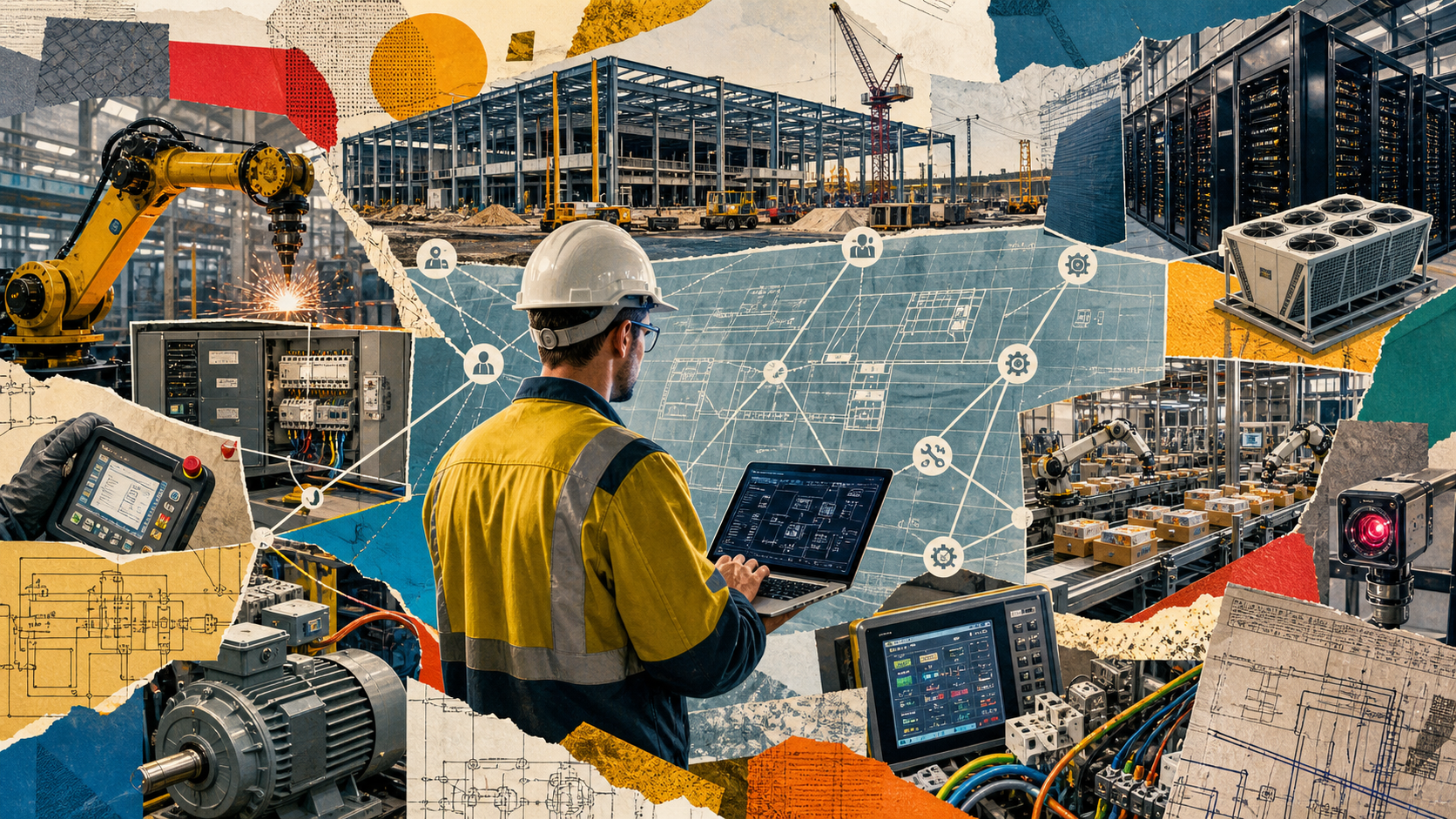
When a new factory gets announced, the headline is usually about the investment number.
$2 billion.
4,000 jobs.
A new battery plant.
A new EV line.
A new AI data center.
A new food plant expansion.
That is the part politicians, executives, and local news outlets like to talk about.
But if you work in automation, controls, robotics, maintenance, electrical, or manufacturing engineering, the more interesting question is:
Who actually makes that plant run?
Because before the first car, battery cell, drone, meal kit, motor, or server cabinet comes off the line, a completely different workforce shows up first.
The public sees the factory announcement.
The automation industry sees the job map.
And if you know what to look for, every plant announcement is really an early warning signal for the kinds of jobs that are about to appear.
The Hidden Jobs Behind a Factory Announcement
A new plant does not go from empty building to full production by magic.
Long before production workers are hired at scale, companies need people who can design, install, debug, commission, and maintain the systems inside the building.
That means jobs like:
- Controls Engineers
- PLC Programmers
- Automation Technicians
- Robot Programmers
- Industrial Electricians
- Maintenance Technicians
- Manufacturing Engineers
- Process Engineers
- Instrumentation Technicians
- SCADA / MES / Data Systems Specialists
- Commissioning Technicians
- Field Service Technicians
- Integration Engineers
- Reliability and Maintenance Leaders
These are the jobs behind the headline.
When a plant is announced, the first wave is often construction, project management, engineering, equipment suppliers, and automation integrators.
Then come the people who install and debug the equipment.
Then come the people who keep it running.
By the time the public hears that a factory is "open," a lot of automation work has already happened.
Example 1: Anduril's Arsenal-1 in Ohio
Anduril's Arsenal-1 project in Ohio is one of the clearest examples of where manufacturing is going.
The company says Arsenal-1 will create more than 4,000 direct jobs and describes it as a major advanced manufacturing site for defense production. The same announcement describes it as the largest single job-creation project in Ohio history.
That headline is massive on its own.
But look underneath it.
A defense manufacturing plant building drones, autonomous systems, and military hardware is not just hiring assemblers. It needs people who understand:
- automated assembly
- electrical integration
- testing systems
- mechanical and electrical troubleshooting
- manufacturing process flow
- production equipment
- quality systems
- robotics and vision
- data capture
- commissioning and launch support
Factory Automation Jobs has seen Anduril technical roles such as Staff Manufacturing Engineer, Space Systems, which is exactly the kind of job family that sits underneath a major advanced manufacturing buildout.
That is the important part.
A factory like this does not only create "manufacturing jobs." It creates an ecosystem of technical jobs around the factory.
For automation workers, a project like Arsenal-1 is not just a news story. It is a signal that a region may need more technicians, controls people, maintenance talent, test equipment support, and manufacturing engineers.
Example 2: NextStar Energy in Windsor
Canada's first commercial-scale EV battery plant is another perfect example.
In March 2026, Ontario officially marked the grand opening of the NextStar Energy battery manufacturing facility in Windsor, describing it as Canada's first commercial-scale advanced battery manufacturing facility and projecting up to 2,500 direct jobs for the region.
Most people hear "battery plant" and think of production workers.
But a battery plant is an automation-heavy environment.
You have material handling, coating, calendaring, formation, aging, testing, conveyors, robotics, safety systems, inspection systems, traceability, clean-room-style process control, and huge amounts of production data.
That creates demand for people who can work around:
- PLCs
- HMIs
- servo systems
- VFDs
- industrial networks
- process controls
- machine safety
- vision inspection
- battery test systems
- MES and data collection
- maintenance troubleshooting
- electrical controls
This is exactly the kind of plant where a good controls engineer or automation technician can become extremely valuable.
And it is not just Windsor. Battery plants tend to pull work into the surrounding supplier base too: machine builders, panel shops, integrators, tooling companies, logistics automation companies, and maintenance contractors.
One plant announcement can quietly create work across a much larger industrial network.
Example 3: Toyota Battery Manufacturing North Carolina
Toyota Battery Manufacturing North Carolina is another example of the job categories hiding behind a battery investment.
On Factory Automation Jobs, we recently had a Controls Engineer – Off Shift role tied to Toyota Battery Manufacturing North Carolina. The role focused on controls engineering for battery manufacturing, including systems used for manufacturing data analytics, new model launches, internal control requirements, and data collection for the battery department.
We also have a current Toyota Battery Manufacturing North Carolina example in the same orbit: an Engineering Technician – Seibi Tech role involving machine setup, electrical equipment, PLCs, robots, cameras, safety systems, machine integration, and troubleshooting.
That is the kind of job most people never think about when they read a plant announcement.
They see "battery plant."
But someone has to make sure the equipment communicates properly.
Someone has to make sure data is collected correctly.
Someone has to support launch.
Someone has to debug the systems when the line does not run.
Someone has to train the plant team.
Someone has to keep the controls architecture from turning into chaos.
That is where automation careers live.
Example 4: Data Centers Are Factories Too
A lot of people do not think of data centers as factory automation jobs.
They should.
The AI boom is driving enormous investment into data centers, and these buildings are packed with electrical, mechanical, cooling, monitoring, and controls infrastructure.
Related Digital and Blackstone announced financing for a $16 billion Oracle data center campus in Saline Township, Michigan, describing it as a project with more than a gigawatt of capacity.
In North Carolina, Jabil announced a roughly $500 million manufacturing facility in Rowan County to support cloud and AI data center customers, with 1,181 projected jobs.
This matters for automation workers because data centers need people who understand:
- electrical distribution
- switchgear
- generators
- UPS systems
- building automation
- cooling systems
- sensors and instrumentation
- SCADA-style monitoring
- commissioning
- maintenance
- controls troubleshooting
On Factory Automation Jobs, we have seen roles like Johnson Controls Controls Systems Technician 2 and Traveling Field Services Technician, where the work overlaps with building automation, commissioning, HVAC/mechanical/electrical troubleshooting, and data-center support.
That is not traditional "factory floor" work, but the skill overlap is obvious.
If you can troubleshoot industrial controls, read electrical drawings, understand sensors, diagnose networks, and work safely around equipment, data centers become a serious career path.
Example 5: Food Plants Still Need Automation People
Food manufacturing does not get the same hype as EVs, drones, or AI data centers.
But food plants are some of the most automation-dependent facilities in the economy.
Packaging lines, conveyors, palletizers, mixers, ovens, refrigeration systems, fillers, case packers, wrappers, labelers, checkweighers, metal detectors, vision systems, and sanitation-friendly electrical equipment all need technical people.
Maple Leaf Foods recently had an Automation Specialist role in Hamilton focused on troubleshooting, servicing, and maintaining automated industrial controls and equipment across production and facility support equipment.
That is the real world of modern food plants.
Not glamorous.
Not always clean.
Often high pressure.
But very real demand.
And for electricians, millwrights, PLC technicians, and automation specialists, food plants can be excellent places to build practical troubleshooting skill because downtime is expensive and the equipment runs hard.
The Jobs Usually Show Up in Waves
The mistake most people make is waiting until a plant is fully open before looking for jobs.
By then, a lot of the best technical work has already started.
A new factory usually creates jobs in stages.
1. Planning and Design
This is where companies need manufacturing engineers, controls engineers, process engineers, electrical designers, safety specialists, and integrators.
The plant is still mostly drawings, equipment specs, vendor quotes, and project schedules.
2. Build and Integration
This is where machine builders, robot programmers, panel builders, PLC programmers, electricians, and installation crews get busy.
Equipment is being built, wired, tested, shipped, installed, and modified.
3. Commissioning and Launch
This is where things get intense.
The line has to run. The bugs show up. Cycle time is not where it should be. Sensors fail. Robots need reteaching. Safety circuits need validation. HMIs need changes. Operators need training. Production wants parts.
This stage creates demand for controls engineers, commissioning technicians, robot programmers, automation specialists, and experienced troubleshooters.
4. Production Ramp-Up
Now the plant is trying to hit real numbers.
This is where maintenance technicians, industrial electricians, reliability engineers, process technicians, controls support, and production engineering become critical.
5. Continuous Improvement
Once the plant is running, the work does not stop.
Plants add new models, new SKUs, new packaging, new tooling, new software, new inspection systems, and new efficiency targets.
That creates long-term work for automation people.
Why This Matters for Job Seekers
If you are a PLC programmer, controls engineer, robot programmer, industrial electrician, or automation technician, you should watch factory announcements differently than the average person.
Do not just ask:
How many jobs did they announce?
Ask:
- What kind of equipment will this plant need?
- Who will build the machines?
- Which integrators will support the launch?
- What suppliers are nearby?
- What roles show up 6 to 18 months before production?
- What maintenance and controls roles will exist once the plant ramps up?
That is how you get ahead of the market.
By the time a plant is hiring hundreds of general production workers, the controls and automation people may already be deep into launch.
Why This Matters for Employers
For employers, the lesson is just as important.
If you are building a plant, expanding a line, opening a battery facility, adding robotics, or modernizing a food plant, your automation hiring cannot be an afterthought.
The shortage is not just "people."
It is people who can actually walk up to a machine that is down and figure out what is happening.
People who understand PLCs, electrical systems, sensors, pneumatics, servos, robots, safety, drawings, networks, and production pressure.
Those people are hard to find.
And when every new plant announcement creates demand for the same skill set, the competition gets worse.
The companies that win will not be the ones that start hiring automation people at the last second. They will be the ones that build a pipeline early.
The Bottom Line
Every new factory announcement is really two stories.
The first story is the one everyone sees:
A new plant.
A big investment.
A politician at a podium.
A promise of jobs.
The second story is the one automation workers should pay attention to:
The equipment has to be designed.
The panels have to be built.
The robots have to be programmed.
The PLCs have to be debugged.
The line has to be commissioned.
The data has to be collected.
The downtime has to be fixed.
The plant has to run.
That is where the real technical careers are.
So the next time you see a headline about a new battery plant, EV plant, food facility, data center, drone factory, or automotive investment, do not scroll past it.
Ask the better question:
What automation jobs are hiding behind this announcement?
Because before the first product rolls off the line, the controls people are already there.
For the role-by-role version of this hidden hiring sequence, read The Automation Jobs Nobody Notices Until the Line Goes Down.
Looking for the Jobs Behind the Announcement?
Browse current controls, PLC, robotics, industrial electrical, and automation roles on Factory Automation Jobs.
Source Notes
- Anduril Arsenal-1 announcement
- Ontario NextStar Energy grand opening release
- North Carolina Commerce Jabil Rowan County announcement
- Related Digital / Blackstone Oracle data center financing announcement
FAQ
What automation jobs are created by new factory announcements?
Common roles include controls engineers, PLC programmers, automation technicians, robot programmers, industrial electricians, manufacturing engineers, process engineers, field service technicians, commissioning technicians, and maintenance leaders.
When do factory automation jobs show up after an announcement?
Many technical roles appear before full production starts, especially during design, equipment build, integration, commissioning, launch, and early ramp-up. Maintenance and continuous-improvement roles continue after the plant is running.
Why do data centers matter for automation workers?
Modern data centers depend on electrical distribution, cooling, building automation, sensors, controls, monitoring, commissioning, and maintenance. Those systems overlap heavily with industrial controls and automation troubleshooting skills.
Use this guide
Turn this into a live factory automation job search
Compare current openings near Ontario, then save an alert so new reviewed PLC, controls, robotics, industrial electrical, commissioning, and field service roles come to you.