
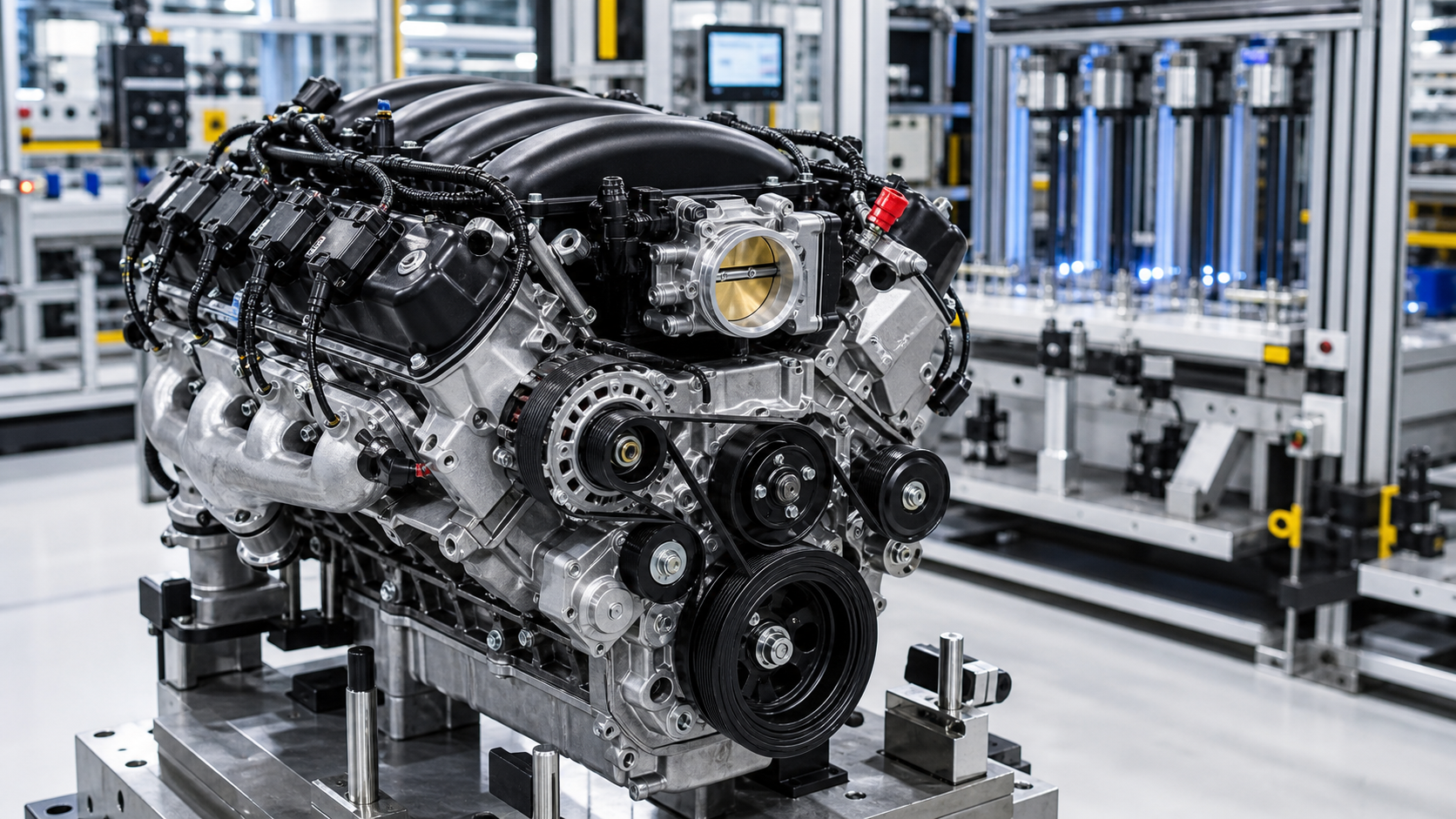
General Motors is spending $691 million at its St. Catharines Propulsion Plant.
Not for an EV battery plant.
Not for a flashy autonomous vehicle project.
Not for some vague ?factory of the future? announcement.
For V8 engines.
Specifically, GM Canada says the money will support production of the company's sixth-generation V8 engine, which will power high-demand full-size trucks and SUVs. Equipment has already started arriving at the St. Catharines site, and the plant will keep producing the current fifth-generation V8 while preparing for the next-generation program.
That might sound like a strange headline in 2026.
For the last few years, the auto industry has talked like everything was going electric tomorrow. Then reality showed up. Full-size trucks still sell. SUVs still sell. Customers still buy V8s. And the companies that build them still need factories capable of producing those engines at scale.
For people in industrial automation, that is the part worth paying attention to.
Because a $691 million plant investment is never just a product story.
It is a machinery story.
A controls story.
A skilled trades story.
A launch story.
A maintenance story.
And eventually, a jobs story.
The boring headline is actually the interesting part
The easy headline is: ?GM invests in V8 engine production.?
The more useful headline is: GM is retooling a major Ontario propulsion plant for one of its core vehicle programs.
That is a very different sentence.
Retooling a plant is where the real industrial work happens. Before anything runs at production rate, there are machines to install, lines to modify, panels to wire, fixtures to debug, safety systems to validate, programs to commission, quality systems to prove out, and production people to train.
Most people read a manufacturing investment announcement and think about the finished vehicle.
Automation people should think about the months before the finished vehicle.
That is where the money turns into work.
This is not some small side project
St. Catharines will become the third GM propulsion plant to produce this next-generation V8, joining Tonawanda Propulsion Plant in Buffalo, New York, and Flint Engine Operations in Michigan. GM says the integrated manufacturing footprint will help it meet demand for high-volume full-size pickups in North America.
That detail matters.
This is not a local maintenance upgrade or a small production tweak. It is part of a broader North American manufacturing strategy around GM?s truck and SUV business.
Reuters reported that GM is putting about $1.4 billion into gas-engine output across plants in the U.S. and Canada, including engines, transmissions, and castings. The move comes as automakers adjust to slower-than-expected EV demand while continuing to serve strong demand for profitable gas-powered trucks and SUVs.
You can argue about whether that is good, bad, short-sighted, realistic, or inevitable.
But if you work in automation, the career signal is pretty clear:
Follow the capital spending.
Where manufacturers spend hundreds of millions of dollars, there is usually work for people who can make machines run.
What kind of jobs show up around a project like this?
GM has not announced a big new hiring number tied directly to the St. Catharines investment, so it would be lazy to pretend this automatically means hundreds of new direct jobs.
But plant investments do not happen in a vacuum.
A project like this touches a whole network of people and companies: OEM equipment builders, tooling shops, system integrators, electrical contractors, machine builders, panel shops, controls contractors, robot programmers, field service techs, industrial electricians, millwrights, and maintenance teams.
The job postings may not all say ?GM.?
That is the point.
Some of the best opportunities around a major plant investment show up one layer away from the headline.
Look for roles like:
- PLC Programmer
- Controls Engineer
- Automation Specialist
- Robot Programmer
- Industrial Electrician
- Maintenance Technician
- Millwright
- Machine Builder
- Commissioning Technician
- Launch Engineer
- Manufacturing Engineer
- Field Service Technician
This is the hidden labour market behind factory announcements.
The public sees the press release.
The industry sees the purchase orders.
That is why nearby Ontario automation roles matter. Current examples in the broader manufacturing ecosystem include BOS Innovations' Controls and Robotics Programmer for automotive assembly, Eclipse Automation's Electrical Designer role in Cambridge, ATS Corporation's automation controls engineering role, and Lakeside Controls' intermediate project engineer role in Mississauga.
Why V8 engines still mean advanced manufacturing
There is a temptation to think ?gas engine? means old technology.
That is not how modern engine plants work.
A propulsion plant is not just people bolting parts together. It is CNC machining, automated assembly, torque monitoring, leak testing, vision inspection, robotics, traceability, conveyors, servo systems, industrial networks, safety PLCs, HMIs, databases, scanners, gauges, and quality checks.
The product may be familiar. The process is not simple.
And when a plant moves from one generation of engine to another, the messy work starts.
Old equipment has to talk to new equipment. Existing lines have to stay productive while new systems are installed. Shutdown windows are tight. Drawings are imperfect. Production wants parts. Engineering wants validation. Maintenance wants something they can actually troubleshoot at 2 a.m.
That is where good automation people become valuable.
Not because they know one software package.
Because they can stand in front of a machine that is not working, with production breathing down everyone?s neck, and figure out what is actually wrong.
The EV transition did not eliminate the old lesson
For years, people talked about the EV transition like it would replace the old manufacturing world overnight.
It did not.
Instead, we are getting something messier: EVs, hybrids, gas vehicles, batteries, transmissions, engines, software, robotics, reshoring, tariffs, demand swings, and political pressure all happening at the same time.
That mess is uncomfortable for executives.
It is not necessarily bad for skilled technical workers.
The more complicated manufacturing gets, the more valuable it is to understand equipment, controls, power, sensors, safety, troubleshooting, and production.
GM?s St. Catharines investment is a good reminder that ?the future of manufacturing? is not one clean storyline.
Sometimes the future is a battery plant.
Sometimes it is a robot cell.
Sometimes it is a data centre.
And sometimes it is a new V8 engine line in Ontario.
This is why automation careers are hard to outsource from reality
A lot of work can be abstracted, automated, outsourced, or done remotely.
But at some point, someone has to stand beside the line.
Someone has to get the machine through runoff.
Someone has to commission the cell.
Someone has to fix the nuisance fault.
Someone has to find the bad sensor.
Someone has to prove the safety circuit.
Someone has to recover the robot.
Someone has to get production running again.
That is the part of manufacturing people outside the industry often miss.
The factory is not just a building. It is a living system of machines, people, constraints, bad assumptions, worn parts, weird faults, and constant pressure.
The people who can work inside that system are not going away.
They are becoming harder to find.
What Ontario workers should take from this
The takeaway is not ?go get a job at GM tomorrow.?
The better takeaway is: watch where manufacturers are spending money.
GM spending $691 million in St. Catharines is a signal. So is its Oshawa Assembly investment for next-generation gas-powered full-size pickup production. GM says it has invested about $3.3 billion in Canadian manufacturing and operations since 2020.
That tells you where serious industrial activity is happening.
For job seekers, that means watching GM, but also watching the companies around GM.
The integrators.
The tooling suppliers.
The electrical contractors.
The machine builders.
The robotics companies.
The maintenance contractors.
The staffing firms that suddenly need controls people yesterday.
That is often where the opportunity shows up first. Start with Ontario controls engineer jobs, Ontario PLC programmer jobs, and current industrial electrician searches if you want to follow the signal into actual postings.
The real story
The interesting thing about this announcement is not that GM still believes in V8s.
The interesting thing is that a major automaker is still willing to put almost $700 million into an Ontario manufacturing plant because it needs that plant for one of its most important vehicle programs.
That says something.
It says high-volume manufacturing is still alive here.
It says old products still require new equipment.
It says automation work follows investment.
And it says skilled trades and controls people should pay attention when capital starts moving.
The engine is the headline.
The factory work behind it is the opportunity.
Looking for Ontario Automation Work?
Browse current PLC, controls, robotics, skilled trades, and automation roles on Factory Automation Jobs.
Source Notes
- GM Canada St. Catharines investment announcement
- GM Canada Oshawa Assembly investment announcement
- Reuters report on GM gas-engine output investments
FAQ
What is GM investing in at St. Catharines?
GM Canada says it is investing $691 million at its St. Catharines Propulsion Plant to support production of the sixth-generation V8 engine for high-demand full-size trucks and SUVs.
Why does a V8 investment matter for automation workers?
Modern engine production depends on CNC machining, automated assembly, robotics, quality systems, sensors, safety systems, PLCs, HMIs, industrial networks, and maintenance support. Retooling a plant creates work around those systems.
Does this mean GM is directly hiring hundreds of automation workers?
GM has not announced a large direct hiring number tied to this investment. The practical signal is broader: major capital spending often creates work across integrators, tooling suppliers, electrical contractors, machine builders, maintenance teams, and automation specialists.
Use this guide
Turn this into a live factory automation job search
Compare current openings near Ontario, then save an alert so new reviewed PLC, controls, robotics, industrial electrical, commissioning, and field service roles come to you.