
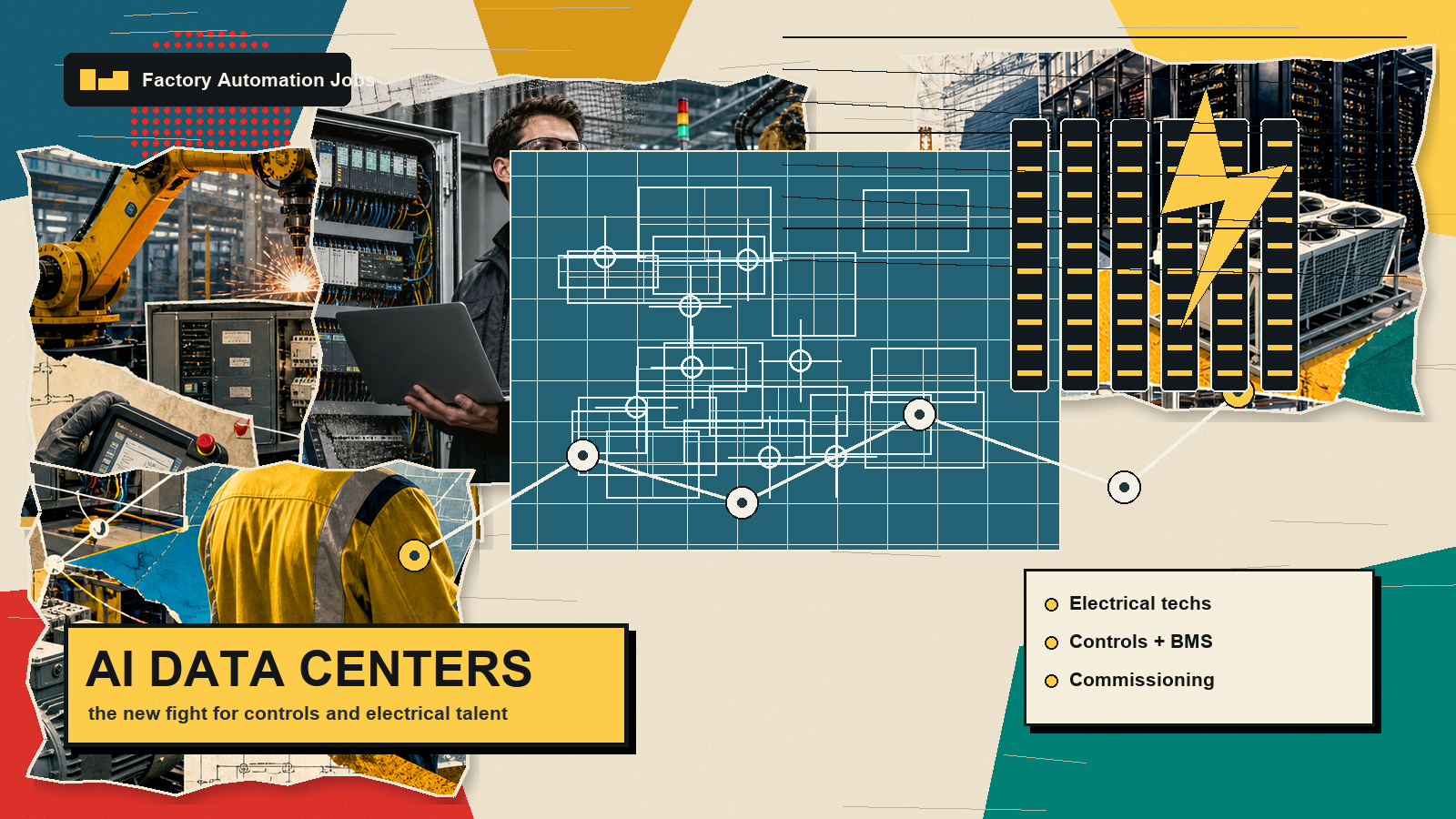
AI data centers are usually talked about like a software story.
GPUs. Models. Cloud capacity. Power demand. Chips. Energy.
But underneath all of that is a much more physical story: someone has to build, wire, commission, operate, maintain, and troubleshoot the infrastructure.
That is where the story becomes very relevant to factory automation.
The same market that needs more data center electrical technicians, building automation specialists, controls support, HVAC technicians, power operators, and commissioning people is pulling from the same broad technical workforce that factories need. If you hire PLC technicians, controls engineers, industrial electricians, instrumentation techs, or automation technicians, this matters.
The AI buildout is now a workforce story
The U.S. Energy Information Administration said in January 2026 that U.S. electricity demand is expected to rise through 2027, driven largely by large computing facilities including data centers.
The International Energy Agency made the broader point in its Electricity 2026 work: after years of stagnant demand in advanced economies, electricity is again becoming a major input for AI, data centers, advanced manufacturing, and electrification.
That means the bottleneck is not only chips. It is also power systems, substations, cooling, switchgear, backup generation, building automation, controls, commissioning, and maintenance.
Deloitte recently looked at U.S. job postings from 2023 through 2025 and found a sharp rise in data center demand for core roles. Its analysis says postings by data centers for electrical technicians climbed more than 180 percent, and 63 percent of data center executives named a shortage of data center-related skilled labor as their top obstacle to securing talent.
That should get every factory employer’s attention.
Factories are competing with data centers for overlapping people
A good factory automation person is not the same as a data center technician. The day-to-day work is different.
But the overlap is real.
- Industrial electricians understand power distribution, panels, motors, drives, troubleshooting, and safety.
- Controls technicians understand sensors, alarms, sequences, networks, and fault recovery.
- Instrumentation technicians understand calibration, signals, devices, and reliability.
- Commissioning people understand startup pressure, documentation, testing, and handoff.
- Automation engineers understand how physical systems behave when software meets equipment.
Those are not easy people to replace.
When data centers, utilities, advanced manufacturers, battery plants, semiconductor fabs, and factories all need versions of that talent at the same time, the hiring market changes.
What this means for job seekers
If you are a PLC technician, industrial electrician, controls engineer, or automation technician, the useful takeaway is not “leave manufacturing for data centers.” The useful takeaway is that your skill set is becoming more valuable across more industries.
Factories still need people who can walk up to a stopped line, connect to the PLC, understand the sequence, check the I/O, read the prints, look at the field device, and get production moving again.
But the market around that person is expanding.
The best move is to make your resume specific. Do not just say “maintenance” or “controls.” Name the systems you have actually supported:
- PLC platforms and HMI systems
- Industrial networks
- VFDs, servos, motors, and drives
- Safety circuits and lockout procedures
- Instrumentation, sensors, and field devices
- Production equipment, packaging lines, conveyors, robots, or process systems
- Commissioning, startup, shutdown, and troubleshooting experience
The more clearly you describe real equipment experience, the easier it is for serious employers to understand your value.
What this means for employers
If your plant needs automation talent, vague job postings are going to hurt you.
A posting that says “maintenance technician” may miss the exact person you want. A posting that says the person will support Allen-Bradley PLCs, troubleshoot VFDs, maintain automated packaging equipment, work with HMIs, and respond to production downtime is much more likely to attract the right candidate.
The same is true for pay and schedule transparency. If the job has rotating shifts, shutdowns, call-ins, commissioning travel, or high downtime pressure, say it clearly. Strong technical workers will ask anyway. Hiding the reality only wastes time.
Employers should also think about training paths. A skilled industrial electrician who wants to learn PLC troubleshooting can become extremely valuable. A maintenance technician with strong mechanical instincts can become an automation technician if the plant gives them structured exposure to controls, prints, sensors, drives, and fault diagnosis.
The companies that grow their own technical people will have an advantage.
The real lesson
AI may be the headline, but the physical infrastructure is the job story.
Data centers need power, cooling, controls, commissioning, and maintenance. Factories need the same kind of practical technical intelligence, pointed at production equipment instead of server halls.
That means the next few years may be very good for people who can bridge electrical, controls, troubleshooting, and real equipment.
It also means factory employers need to compete like they understand that reality.
Looking for this kind of work? Browse current controls, electrical, and automation jobs, or create a job alert for new factory automation roles.
Source Notes
- U.S. Energy Information Administration: January 2026 Short-Term Energy Outlook press release
- International Energy Agency: Electricity 2026 demand analysis
- Deloitte: Data centers and power companies compete for the same core workforce
- CBRE and Meta: LevelUp technician training announcement
FAQ
Why do AI data centers matter for factory automation jobs?
AI data centers need electrical, controls, cooling, commissioning, maintenance, and monitoring talent. Those skills overlap with the PLC, industrial electrical, instrumentation, and automation technician workforce that factories also need.
Are data center jobs the same as factory automation jobs?
No. The environments are different, but the skill overlap is real: electrical troubleshooting, controls, sensors, alarms, networks, commissioning, and maintenance all matter in both markets.
What should employers do if they need controls or electrical talent?
Employers should make job postings specific. Name the PLCs, HMIs, drives, panels, shift expectations, downtime pressure, commissioning needs, and actual equipment instead of using generic maintenance or technician wording.
Job alerts
Get new factory automation jobs by email
Save a focused alert and we will send new reviewed PLC, controls, robotics, industrial electrical, commissioning, and field service roles when they match.