
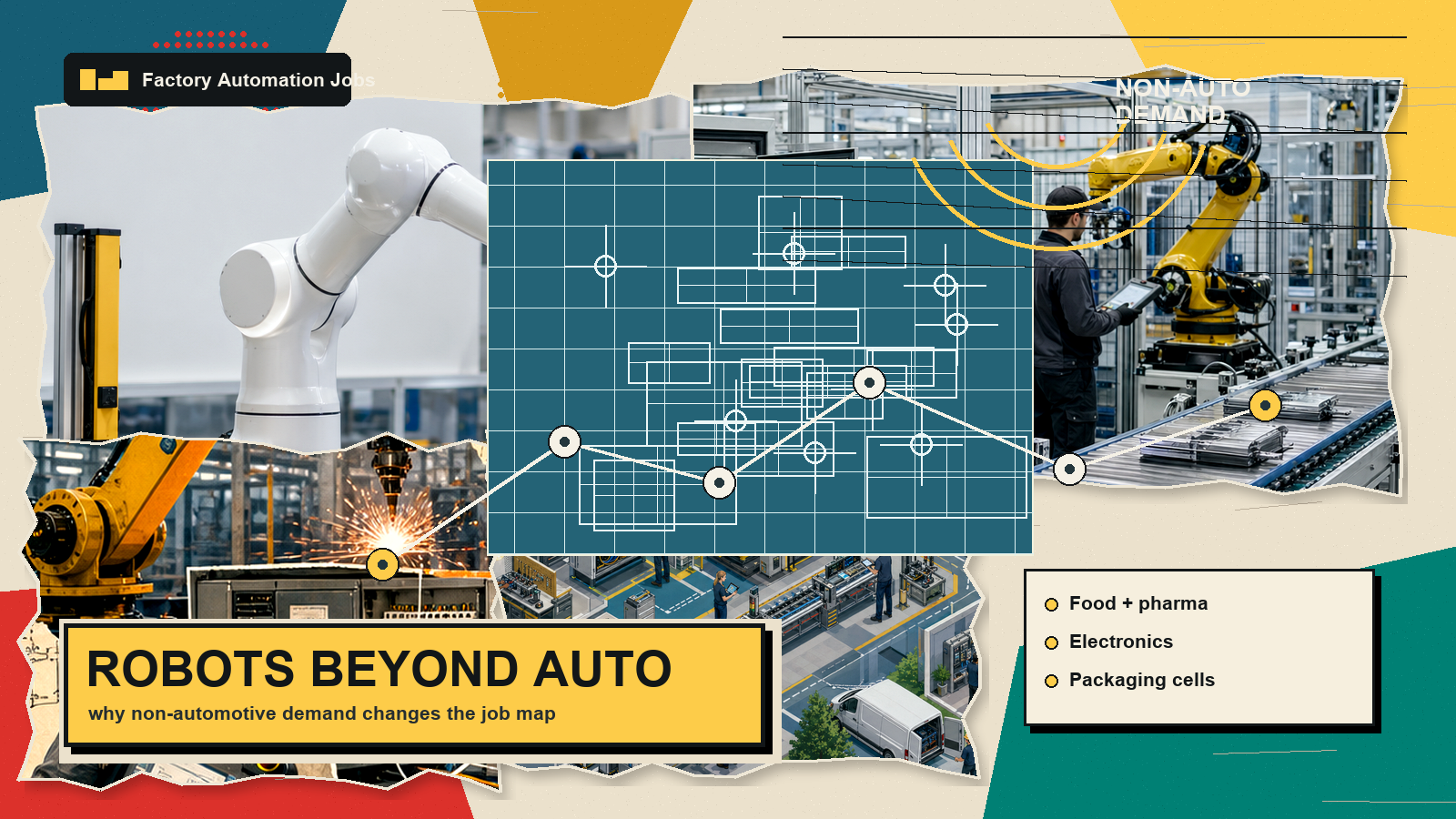
For a long time, North American robotics felt like an automotive story.
That was not wrong. Automotive plants and automotive suppliers have been some of the biggest users of industrial robots for decades.
But the more interesting story now is where robot demand is spreading.
The Association for Advancing Automation reported that North American companies ordered 9,055 robots in the first quarter of 2026, valued at $543 million. Overall unit orders were basically flat compared with Q1 2025, but the industry mix is the part automation people should care about.
Automotive OEM orders were down sharply, while several non-automotive sectors posted strong gains, including life sciences, electronics, food and consumer goods, plastics and rubber, and other industries.
That is a useful signal for job seekers and employers.
The robot job market is getting wider
When robotics demand is concentrated in automotive, the career map is more obvious: auto plants, Tier 1 suppliers, weld cells, assembly lines, body shops, powertrain, launch work, and integrators serving those customers.
Those markets still matter. A lot.
But if food, life sciences, electronics, plastics, consumer goods, logistics, and smaller manufacturers keep adding robots, the work starts showing up in more places.
- Packaging lines
- Palletizing and depalletizing
- Machine tending
- Inspection and vision systems
- Lab automation and life-sciences handling
- Electronics assembly and test
- Plastic part handling and downstream automation
- End-of-line automation
That is good for robot programmers, robotics technicians, controls engineers, automation technicians, and industrial electricians who understand safety, tooling, sensors, and recovery.
Robots still need the rest of the cell
The public tends to see the robot arm. The plant sees the whole cell.
A robot almost never works alone. It usually needs guarding, safety scanners, conveyors, fixtures, tooling, grippers, vision, PLC logic, HMI screens, part-present sensors, reject handling, operator recovery, and production support.
That is why broader robot adoption creates more than “robot programmer” jobs.
It creates demand for people who can make robot cells production-ready.
A robot programmer may touch up points, write routines, build recovery moves, and manage frames or tooling. A controls engineer may integrate the robot with the PLC, safety system, HMI, and upstream or downstream equipment. An industrial electrician may wire panels, troubleshoot sensors, verify safety devices, and help debug field issues. An automation technician may be the person who gets called at 2 a.m. when the robot faults and production is waiting.
The arm is the visible part. The job market is in the system around it.
Collaborative robots are becoming part of the signal
A3’s 2025 statistics also show why collaborative robots deserve attention. A3 reported 36,766 robots ordered in North America in 2025, valued at $2.25 billion. Collaborative robots accounted for 7,212 of those units.
That does not mean cobots replace traditional industrial robots. It means the menu of realistic automation options is expanding.
For smaller manufacturers, a cobot may be the first robot they can justify. For larger manufacturers, collaborative or easier-to-deploy robots can open up applications that were previously too awkward, too small, or too changeable for a traditional cell.
But easier programming does not remove the need for automation knowledge.
Someone still has to understand payload, cycle time, safety, tooling, reach, part variation, recovery, fixtures, and how the cell fits into production. The interface may get easier. The real-world problems remain real.
Why this is good for job seekers
If you want to work in robotics, do not only look for the word “robot programmer.”
Search for adjacent roles too:
- Automation technician
- Controls technician
- Controls engineer
- PLC programmer
- Field service technician
- Commissioning technician
- Industrial electrician
- Machine builder
- Vision systems technician
Many robotics jobs hide under broader automation titles. A packaging plant may not advertise “robot programmer” if the robot is only one part of the line. A system integrator may list a controls role that includes robot integration. A plant maintenance role may include robot recovery and troubleshooting, even if the title does not say robotics.
The best resume strategy is to show the cell, not just the robot brand. Mention robots you have worked with, but also mention PLCs, HMIs, safety, tooling, vision, conveyors, and troubleshooting outcomes.
Why this is good for employers
If your company is adding robots outside the traditional automotive world, your job postings need to explain the work clearly.
Do not assume candidates will understand your environment from the title alone. A robotics technician role in food manufacturing is different from one in automotive welding. A robot programmer supporting machine tending is different from one supporting material handling, inspection, or palletizing.
Good candidates want to know:
- Which robot brands are used
- Which PLC and HMI platforms are connected to the cell
- Whether the job includes programming, troubleshooting, or both
- Whether travel or commissioning is required
- What shift, overtime, and support expectations look like
- Whether training is available for the right automation candidate
Specificity helps the right people self-select.
The real story
The robotics market does not need every quarter to be a record to be important.
The more useful signal is that robotics demand is broadening. As more industries adopt robots, automation careers become less tied to one sector.
That is healthy for the job market.
It means a robotics career can run through automotive, food, pharma, electronics, plastics, packaging, logistics, machine building, integration, and field service. The common thread is not the industry. It is the ability to make automated equipment work in the real world.
Looking for robotics work? Browse current robotics and robot programmer jobs, or create a robotics job alert.
Source Notes
FAQ
Why is non-automotive robot demand important for job seekers?
It means robotics work is spreading into more industries such as food, life sciences, electronics, plastics, packaging, and consumer goods, creating more paths for robot programmers, controls engineers, and automation technicians.
What jobs are connected to robot adoption?
Robot adoption can create demand for robot programmers, robotics technicians, controls engineers, PLC programmers, industrial electricians, field service technicians, commissioning technicians, and vision or automation specialists.
Should candidates only search for robot programmer jobs?
No. Many robotics opportunities are hidden under broader titles such as automation technician, controls engineer, PLC programmer, field service technician, commissioning technician, or industrial electrician.
Job alerts
Get new robotics jobs by email
Save a focused alert and we will send new reviewed PLC, controls, robotics, industrial electrical, commissioning, and field service roles when they match.