
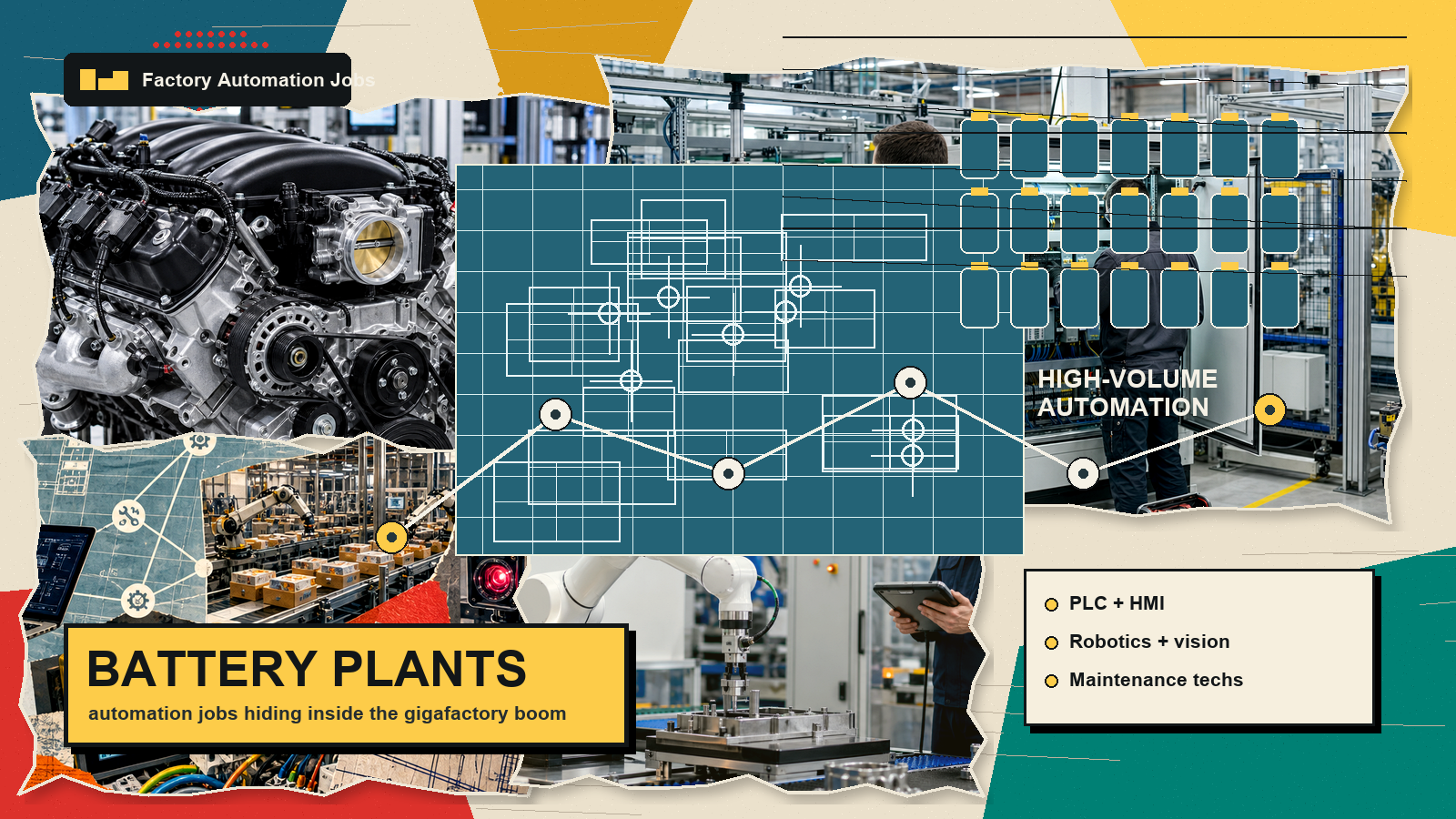
Battery plants are usually discussed as EV projects, energy projects, or supply-chain projects.
That is true, but it misses the part job seekers and employers should watch closely.
Battery plants are automation plants.
They rely on high-volume production equipment, robotics, material handling, quality systems, traceability, smart carts, conveyors, automated inspection, controls, maintenance, and technical production support.
That makes them highly relevant to Factory Automation Jobs.
The public sees batteries. The plant sees equipment.
AESC says its gigafactories use 95 percent automation with advanced robotics and smart systems. Toyota describes its North Carolina battery plant as its first electric battery plant in North America and says it is building a team of more than 5,000 people in Liberty, North Carolina. Honda’s Ohio EV Hub includes a $4.4 billion joint venture battery company with LG Energy Solution and more than $1 billion to retool several Ohio plants.
Those are not small signals.
When a company builds or retools a plant at that scale, the work is not only assembly. It is equipment installation, startup, controls integration, maintenance planning, safety validation, quality systems, material handling, and the constant effort to keep automated lines running.
That is where automation careers show up.
Battery jobs are not only operator jobs
Production team member roles matter. Operators are essential to any plant.
But the technical layer around battery production is where many of the strongest career paths sit.
- Automation technicians who support high-tech production equipment
- Maintenance technicians who troubleshoot electrical and mechanical systems
- Controls engineers who support PLCs, HMIs, data, and line logic
- Industrial electricians who keep panels, drives, power, and field devices working
- Robotics technicians who support handling, inspection, and material movement
- Quality and reliability people who understand process control and equipment behavior
- Commissioning and field service teams who help launch new equipment
Those roles are not always advertised with the word “battery” in the title. They may appear as maintenance engineering technician, automation engineer, controls technician, manufacturing engineer, industrial electrician, equipment technician, reliability technician, or robotics support.
The job title can be boring. The equipment may not be.
The skill mix is broader than one trade
Battery manufacturing rewards people who can cross boundaries.
A technician may need to understand sensors, motors, pneumatics, conveyors, drives, machine guarding, cameras, industrial networks, electrical prints, and the logic sequence that connects everything together.
A controls engineer may need to think about line uptime, quality traceability, recipe handling, safety, alarms, operator recovery, and how changes affect production.
An industrial electrician may still need classic electrical fundamentals, but the strongest candidates will also understand automation equipment, PLC troubleshooting, VFDs, HMIs, and the plant’s production process.
This is why battery plants can be good career accelerators for people who want technical manufacturing experience.
Why this matters even when EV demand shifts
EV demand can move up and down. Automakers can delay programs, change product strategy, or shift capital spending. That is normal in automotive.
But the bigger lesson remains useful: modern production work is becoming more automated, more data-heavy, and more dependent on technical support.
A person who learns how to troubleshoot high-volume battery equipment is not only learning “battery.” They are learning equipment behavior, controls, quality, downtime recovery, and production support in a high-pressure manufacturing environment.
Those skills transfer.
They can transfer into automotive, packaging, food and beverage, electronics, life sciences, consumer goods, logistics, and system integration.
What job seekers should do
If you are interested in battery manufacturing, search for more than the obvious words.
Try combinations like:
- battery automation technician
- maintenance engineering technician
- controls engineer battery
- industrial electrician battery plant
- equipment technician manufacturing
- robotics technician manufacturing
- manufacturing engineer automation
When you read a posting, look for real technical signals: PLCs, HMIs, drives, robots, sensors, industrial controls, machine operation, automated equipment, line support, quality systems, safety, and troubleshooting.
If those signals are there, the role may be more valuable than the title suggests.
What employers should do
Employers in battery and EV manufacturing should avoid generic postings when they need automation talent.
If the job involves controls, say so. If it involves PLC troubleshooting, say so. If it supports automated equipment, conveyors, smart carts, robotics, vision, or high-speed production lines, make that clear.
A good automation candidate is not just looking for a job. They are trying to understand whether the work will build their skill set.
Specific postings attract more serious technical candidates because they prove the employer understands the role.
The real story
Battery plants are not just a clean-energy headline.
They are a manufacturing reality: automated equipment, technical maintenance, controls, robotics, commissioning, quality, and uptime.
For job seekers, that means battery plants can be a serious place to build automation experience.
For employers, it means the hiring competition is for people who can keep advanced equipment running, not just people who can fill a shift.
Looking for battery-adjacent automation work? Browse current battery, controls, and automation jobs, or create a battery automation job alert.
Source Notes
- AESC U.S. careers and gigafactory information
- Toyota Battery Manufacturing North Carolina careers page
- Honda EV Hub information
FAQ
Why are battery plants automation plants?
Battery manufacturing depends on high-volume automated equipment, robotics, material handling, controls, quality systems, traceability, sensors, drives, safety systems, and technical maintenance support.
What automation jobs exist around battery plants?
Common roles include automation technician, controls engineer, maintenance technician, industrial electrician, robotics technician, equipment technician, manufacturing engineer, and commissioning support roles.
Do battery plant skills transfer to other industries?
Yes. Troubleshooting high-volume equipment, PLCs, HMIs, drives, robots, sensors, quality systems, and production downtime can transfer to automotive, packaging, food, electronics, logistics, and system integration roles.
Job alerts
Get new factory automation jobs near Ohio by email
Save a focused alert and we will send new reviewed PLC, controls, robotics, industrial electrical, commissioning, and field service roles when they match.