
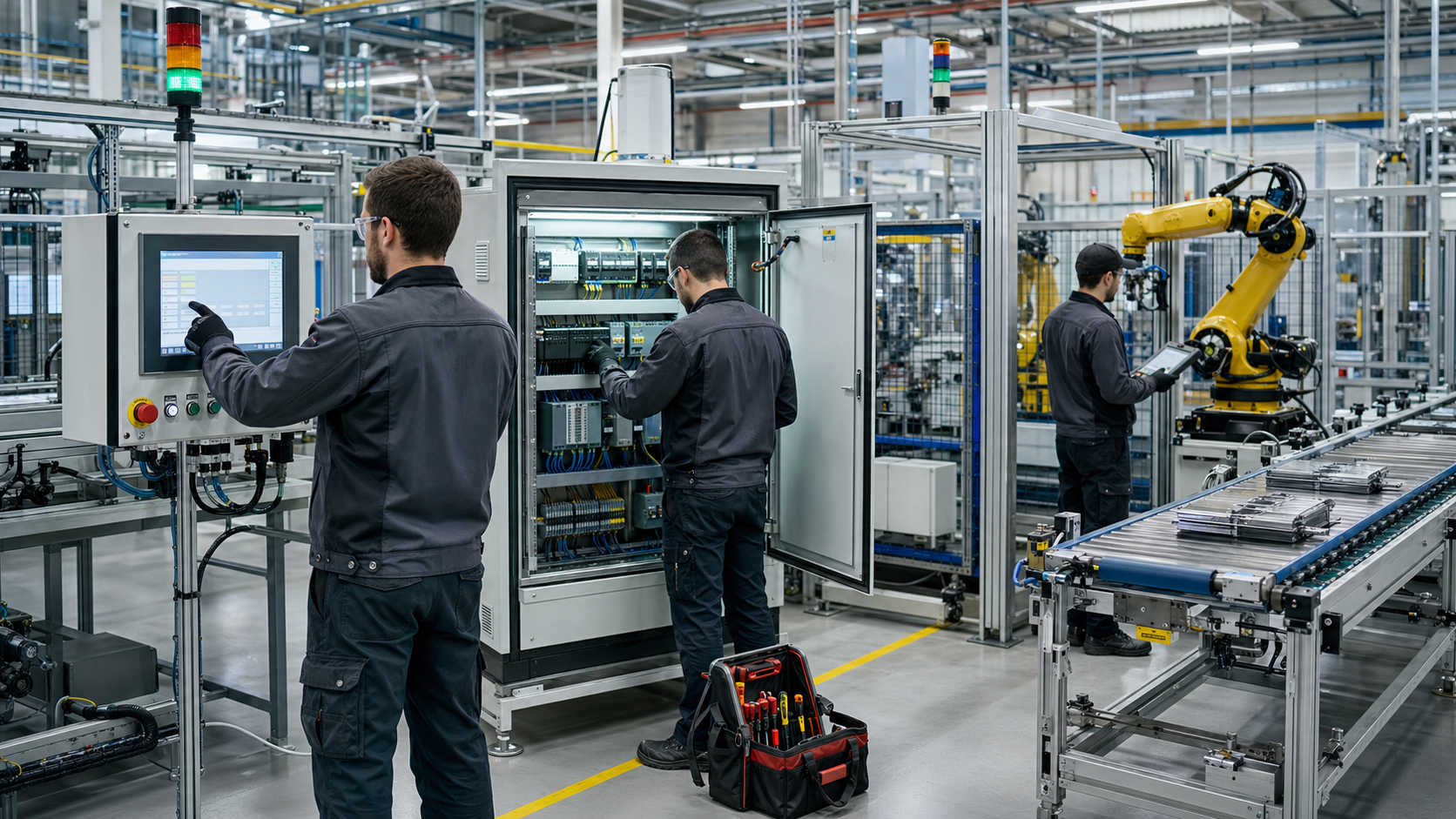
Nobody cares about the PLC programmer when the line is running.
They care when the conveyor stops, the robot faults, the vision camera rejects every part, the VFD trips, the HMI alarm list fills up, and production wants to know whether this is a five-minute reset or a lost shift.
That is the strange thing about factory automation work. When it is done well, it disappears. The machine cycles. The robot picks the part. The sensor sees what it is supposed to see. The drive follows speed. The HMI makes sense. The safety circuit behaves. The operator hits start and the equipment does what everyone expects.
Then one input does not change state, one robot handshake gets missed, one interlock is not satisfied, one cylinder does not extend, one barcode reader fails to read, one safety gate will not reset, or one servo refuses to home.
Suddenly the most important person in the building is not the person talking about automation in a boardroom. It is the person standing beside the machine trying to figure out what the PLC actually sees.
That is the job market Factory Automation Jobs is built around.
Not generic tech jobs. Not broad engineering jobs. Not office automation. Not software automation. Factory automation jobs: PLCs, controls, robotics, automation technicians, industrial electricians, commissioning people, field service techs, and the workers who keep automated production equipment alive.
Looking for real plant-floor automation work? Browse PLC, controls, robotics, automation technician, and industrial electrician jobs across Canada and the U.S.
The jobs behind the alarm list
Most people outside manufacturing see automation as a clean idea. Robots, smart factories, lights-out production, AI, dashboards, and polished press photos.
People who work around real production equipment know better.
Automation is wires, sensors, drawings, panels, I/O cards, Ethernet drops, VFD parameters, air pressure, dirty photoeyes, bent brackets, bad prox alignment, half-updated HMI screens, missing permissives, inconsistent part presentation, and equipment that ran fine on day shift but decided to ruin nights.
The job titles behind that work are messy, but the work is real.
A company may call the role:
- PLC Programmer
- Controls Engineer
- Automation Technician
- Robot Programmer
- Industrial Electrician
- Controls Technician
- Electrical Controls Specialist
- Automation Engineer
- Commissioning Technician
- Field Service Technician
- Mechatronics Technician
- Robotics Technician
- Maintenance Electrician
- Instrumentation and Controls Technician
Some of those titles overlap. Some are badly written by HR. Some are accurate only inside one company. A “controls technician” at one plant may do more real PLC troubleshooting than a “controls engineer” somewhere else. A “maintenance electrician” with strong PLC and drive skills may be more useful during downtime than a programmer who has never worked outside a laptop.
That is why job seekers in this field cannot search only one title. If you search too narrowly, you miss good jobs. If you search too broadly, you drown in garbage.
The real trick is understanding what belongs in the automation job market and what does not.
PLC programmers make the machine decide
A PLC programmer is not just someone who writes ladder logic.
At the plant-floor level, the PLC programmer is dealing with the decision-making layer of the machine. What has to be true before the conveyor starts? What signal tells the robot it can enter the fixture? What happens if the part-present sensor is made but the clamp-closed sensor is not? What fault should stop the machine immediately, and what fault should let the current cycle finish?
That work is not abstract. It has consequences.
A bad sequence can crash tooling. A missing interlock can damage equipment. A sloppy fault routine can turn a simple sensor issue into an hour of guessing. A confusing HMI alarm can make maintenance chase the wrong problem. A poor manual mode can make setup painful. Bad recovery logic can make operators hate the machine.
Good PLC work shows up when something goes wrong and the machine still gives people a reasonable path back to production.
Typical PLC programmer jobs may involve:
- Studio 5000 or RSLogix work
- Siemens TIA Portal work
- Omron Sysmac Studio work
- HMI development or edits
- I/O checkout
- machine sequencing
- fault logic
- startup and commissioning
- troubleshooting live equipment
- working with electricians, robot programmers, mechanical trades, and production teams
If you are searching for this type of work, do not search only “PLC programmer.” Also search controls programmer, automation programmer, controls technician, commissioning technician, electrical controls specialist, and automation engineer.
Browse current PLC programmer jobs in Ontario.
Browse current PLC programmer jobs in Michigan.
Controls engineers are where the systems collide
Controls engineer is one of the most abused job titles in manufacturing.
At one company, it means PLC programming and commissioning. At another, it means plant support and troubleshooting. At another, it means electrical design, safety circuits, network architecture, HMI standards, vendor management, project ownership, and being the person everyone calls when nobody else knows whether the problem is mechanical, electrical, software, process, or operator-related.
That is why controls jobs are hard to hire for. The title is simple. The work is not.
A good controls person has to understand how the system fits together. The PLC logic is part of it, but so are field devices, panels, drawings, safety, drives, networks, robots, process conditions, maintenance habits, operator behavior, and the ugly reality of equipment that has been modified five times since installation.
The controls engineer often lives in the gap between design and reality.
The drawing says one thing. The panel says another. The customer standard says something else. The machine builder did it a different way. The plant added a bypass three years ago. The operator has a trick that is not in the manual. The HMI alarm says “station fault,” which means almost nothing.
That is where real controls ability matters.
Typical controls engineer jobs may involve:
- PLC and HMI programming
- electrical control system design
- troubleshooting automated equipment
- robot and PLC integration
- safety circuits and safety PLCs
- VFDs, servos, and motion
- industrial networks
- commissioning and launch support
- plant upgrades
- working with integrators, OEMs, and production teams
The best controls people are not just “good with software.” They are good at figuring out what the machine is doing, what it should be doing, and what condition is preventing it from getting there.
Browse current controls engineer jobs in Ontario.
Browse current controls engineer jobs in Michigan.
Robot programmers are not working in science fiction
Industrial robot programming is not the same as the robotics content most people see online.
A factory robot programmer is usually not building a humanoid robot or training a research model. They are dealing with robot cells that weld, pick, place, load, unload, palletize, dispense, tend machines, move parts, or work around fixtures, conveyors, tooling, clamps, sensors, and safety zones.
The work is practical.
Can the robot reach the point? Is the path clean? Is the torch angle right? Is the part actually where the robot expects it to be? Is the gripper closed? Did the PLC send the correct permission? Did the robot send the complete signal back? Can the cell recover after an E-stop? Does the operator know what to do after a fault? Is the cycle time acceptable? Is the robot waiting because of a PLC handshake, a sensor, a safety condition, or bad logic?
Robot programmers often work close to PLC programmers and controls engineers because the robot rarely exists by itself. It is part of a cell. The cell is part of a line. The line is part of production. That means robot programming is often tied to PLC handshakes, safety circuits, HMI messages, fixtures, conveyors, vision, barcode readers, and plant support.
Common robot platforms in industrial environments include FANUC, ABB, KUKA, and Yaskawa/Motoman. The exact brand matters, but the bigger skill is understanding how robots behave inside production systems.
Typical robot programming and robotics jobs may involve:
- teach pendant programming
- path programming and touchups
- robotic welding
- material handling
- palletizing
- machine tending
- robot recovery
- robot-to-PLC handshakes
- tooling and fixture coordination
- cell commissioning
- cycle-time improvement
- production support
When searching, do not use only “robot programmer.” Also search robotics technician, robotic technician, robot specialist, controls and robotics programmer, automation technician, robot support technician, and manufacturing automation roles.
Browse current robot programmer jobs in Ontario.
Browse current robot programmer jobs in Michigan.
Automation technicians are often the first useful line of defense
Automation technician is one of the most practical job titles in this market because it sits close to the equipment.
A good automation technician may not be writing a full PLC program from scratch, but they can often do the work that keeps a line from bleeding hours: check whether the PLC sees an input, verify that an output is turning on, understand a basic sequence, read an HMI alarm, look at a VFD fault, check a sensor, identify a safety reset issue, and explain the problem clearly enough that the right person can fix it.
That is valuable.
A production line does not always need a senior controls engineer for every issue. Sometimes it needs someone who can stop guessing.
Is the photoeye blocked or is the input dead? Is the prox made at the device but not at the PLC? Is the cylinder not extending because there is no output, no air, a bad valve, a mechanical jam, or a missing permissive? Is the VFD faulted because of overload, communication loss, bad parameters, or an actual mechanical problem? Is the HMI alarm useful or just a vague message that hides the real condition?
Automation technicians live in that middle ground between maintenance, controls, electrical, and production.
Typical automation technician jobs may involve:
- PLC troubleshooting
- HMI alarm diagnosis
- sensor and field-device checks
- VFD troubleshooting
- electrical prints
- robot cell support
- automated equipment maintenance
- production support
- working with controls engineers and electricians
- helping recover machines after faults
This can be one of the best paths for maintenance workers who want to move toward controls without pretending they are already full-time PLC programmers.
Browse current automation technician jobs in Ontario.
Industrial electricians keep automation attached to reality
Factory automation still runs through real hardware.
Wires. Panels. Breakers. Fuses. Terminal blocks. Contactors. Drives. Motors. Sensors. Solenoids. Safety devices. Junction boxes. Disconnects. Cable trays. Grounding. Prints. Lockout. Troubleshooting.
That is why industrial electricians are central to automation work.
A programmer can write perfect logic and still be useless if the input never changes state. A robot can have a perfect path and still sit waiting if the gripper feedback never makes it back to the PLC. A drive can be commanded to run and still fault because the motor, load, wiring, parameters, or power side is wrong.
The best industrial electricians in automated plants are not just wire pullers or part swappers. They understand how electrical work connects to machine behavior.
They can read prints. They can troubleshoot safely. They can check I/O. They understand sensors, drives, motors, control panels, and field wiring. They know that “the PLC is bad” is usually the wrong first assumption. They can work with controls people without turning every problem into a blame contest.
Industrial electrician jobs with real automation exposure may involve:
- PLC troubleshooting
- VFDs and motor controls
- sensor replacement and alignment
- control panel troubleshooting
- automated equipment support
- safety circuits
- electrical drawings
- HMI alarms
- production maintenance
- plant upgrades
- working with controls engineers and automation technicians
For electricians who want better automation exposure, the best searches are usually not just “electrician.” Search industrial electrician, maintenance electrician PLC, electrical controls technician, automation electrician, PLC electrician, controls electrician, and instrumentation and controls technician.
Browse current industrial electrician jobs in Ontario.
Browse current industrial electrician jobs in Michigan.
The job titles are messy because the work is messy
One of the biggest mistakes job seekers make in factory automation is assuming titles are standardized.
They are not.
A PLC programmer at an integrator may spend half the year commissioning machines at customer plants. A controls engineer at a manufacturer may spend most of the week supporting production and fixing issues that maintenance cannot solve. An automation technician may do more useful troubleshooting than someone with “engineer” in the title. An industrial electrician may be the strongest PLC troubleshooter on night shift.
The title matters, but it does not tell the whole story.
What matters more is the equipment, tools, and responsibility inside the job description.
Look for words like:
- PLC
- HMI
- controls
- automation
- robotics
- robot cell
- commissioning
- troubleshooting
- I/O
- VFD
- servo
- motion
- sensors
- safety circuit
- electrical drawings
- production equipment
- plant support
- field service
- startup
- launch
Those words tell you more than the title does.
Also watch for employer type. A controls role at a systems integrator is not the same as a controls role inside a plant. A plant job may offer deeper ownership of one facility. An integrator job may expose you to more machines, more customers, more industries, more travel, and more chaos. A machine builder may teach you equipment from design through runoff. A manufacturer may teach you what happens after launch when production has to live with the machine every day.
None of these paths is automatically better. They build different kinds of people.
Factory automation jobs are not generic tech jobs
The word “automation” has been diluted.
Software companies use it. Office tools use it. Marketing tools use it. IT teams use it. AI startups use it. Warehouse software vendors use it. Consultants use it. Sometimes the word means almost nothing.
Factory automation is different because it has to touch the physical world.
A sensor is either made or it is not. A motor either turns or it does not. A robot either reaches the point or faults. A cylinder either extends or sticks. A safety circuit either resets or refuses to. A conveyor either moves parts or creates a pileup. Production either runs or stops.
That physical constraint is what makes these jobs valuable.
You cannot fake your way through downtime for very long. Eventually, someone has to open the panel, look at the HMI, check the logic, verify the input, read the print, inspect the device, understand the sequence, and make a call.
That is why this market deserves its own job board.
Generic job boards bury these roles under software automation, IT automation, construction electrical work, mechanical engineering, production operator jobs, warehouse jobs, and maintenance roles that may have nothing to do with real controls work.
A useful automation job board should be narrower than that.
It should help people find the jobs where PLCs, controls, robotics, electrical troubleshooting, commissioning, and automated production equipment are actually part of the work.
How to search for better automation jobs
If you are looking for better factory automation work, do not rely on one job title.
Build searches around clusters.
For PLC-heavy work, search:
- PLC Programmer
- Controls Programmer
- Automation Programmer
- PLC Technician
- Controls Technician
- Commissioning Technician
- Electrical Controls Specialist
For controls-heavy work, search:
- Controls Engineer
- Automation Engineer
- Electrical Controls Engineer
- Controls Specialist
- Controls Designer
- Systems Integrator
- Controls Technician
For robotics-heavy work, search:
- Robot Programmer
- Robotics Technician
- Robotic Technician
- Controls and Robotics Programmer
- Robot Specialist
- Automation Technician Robotics
- Robot Cell Technician
For industrial electrical automation work, search:
- Industrial Electrician
- Maintenance Electrician PLC
- Electrical Controls Technician
- Automation Electrician
- PLC Electrician
- Instrumentation and Controls Technician
- Industrial Maintenance Electrician
For plant-floor support work, search:
- Automation Technician
- Maintenance Technician Automation
- Mechatronics Technician
- Equipment Technician
- Manufacturing Automation Technician
- Field Service Technician Automation
- Commissioning Technician
The best jobs are often hidden behind imperfect titles. That does not mean you should apply to everything. It means you should read for the work, not just the title.
If the job description mentions PLCs, HMIs, drives, robot cells, sensors, safety circuits, automated equipment, commissioning, or plant-floor troubleshooting, it may belong in your search.
If it is generic warehouse work, software-only automation, construction-only electrical, office process automation, or broad maintenance with no controls content, it probably does not.
The jobs behind every new factory
When a new factory, plant expansion, battery facility, automotive line, food plant, or robotics-heavy operation gets announced, the public usually sees the headline first.
Automation workers should see the hiring sequence.
Before production starts, somebody has to design the control system. Somebody has to build and wire panels. Somebody has to program the PLCs and HMIs. Somebody has to set up drives. Somebody has to integrate robots. Somebody has to check I/O. Somebody has to debug sensors. Somebody has to validate safety. Somebody has to commission the equipment. Somebody has to support launch. Somebody has to keep the line running after the press photos are over.
That is where the hidden job market is.
Factory announcements are not just business news. They are signals for controls engineers, PLC programmers, robot programmers, automation technicians, industrial electricians, commissioning techs, and field service people.
The ribbon-cutting is the last thing the public sees. The automation work starts long before that.
Browse the roles that keep factories running
Factory automation is not one job. It is a cluster of overlapping trades and technical roles around automated production equipment.
The people in this market program, wire, commission, troubleshoot, support, and improve the machines that modern factories depend on.
That includes:
- PLC programmers who build and debug machine logic
- controls engineers who make systems work together
- robot programmers who keep cells moving
- automation technicians who troubleshoot the equipment directly
- industrial electricians who keep the electrical and control hardware honest
- commissioning and field service people who get equipment running in the real world
The work is not always clean. The titles are not always consistent. The job descriptions are not always written by people who understand the equipment.
But the demand is real because automated factories do not run on slogans. They run on people who can find the missing input, bad sensor, faulted drive, broken sequence, robot issue, wiring problem, or controls mistake that is keeping production down.
Find the jobs behind automated factories: PLC programming, controls engineering, robotics, automation technician, commissioning, field service, and industrial electrical roles.
Final thought
The automation jobs nobody notices are often the ones that matter most when production is on the floor waiting.
Nobody celebrates a clean I/O checkout. Nobody writes a press release about a good fault routine. Nobody outside the plant notices when a robot cell recovers properly after an E-stop or when an electrician finds the real reason an input never made it back to the PLC.
But those details decide whether automated factories actually run.
That is the market worth watching.
Use this guide
Turn this into a live factory automation job search
Compare current openings near Ontario, then save an alert so new reviewed PLC, controls, robotics, industrial electrical, commissioning, and field service roles come to you.